
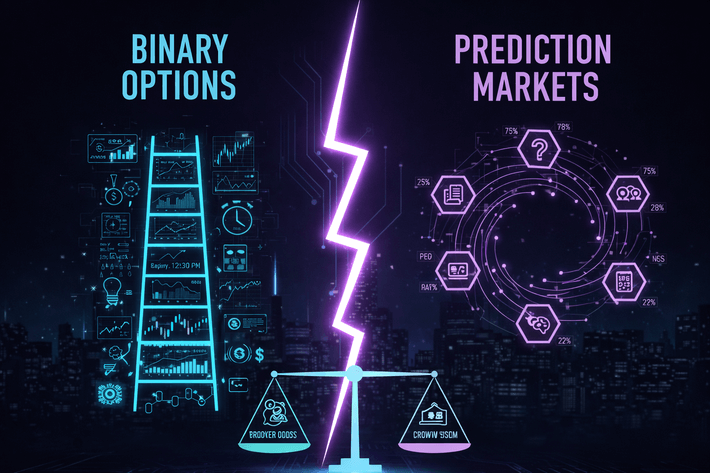
Binary options and prediction markets both offer high-stakes, all-or-nothing trading based on binary (yes/no) outcomes, but their fundamental differences create distinct trading ecosystems that favor different trader profiles. While binary options focus on financial assets with broker-set prices, prediction markets use crowd-sourced probability pricing for real-world events. These differences in asset focus, pricing mechanisms, and regulatory frameworks determine which platform type maximizes your trading edge.
Binary Options vs Prediction Markets: The 3 Critical Differences That Determine Your Success

Binary options and prediction markets differ fundamentally in asset focus, pricing mechanisms, and regulatory frameworks—these differences create distinct trading ecosystems that favor different trader profiles. Understanding these core distinctions helps traders choose the platform that aligns with their expertise and trading goals.
Asset Focus: Why Your Expertise Determines Which Market Wins
Binary options excel for traders with technical analysis skills and market timing expertise, while prediction markets reward those with deep knowledge of political, economic, or sporting events. Binary options platforms offer Forex pairs, stocks, commodities, and cryptocurrency pairs—assets that respond to technical indicators and market sentiment. Prediction markets, however, focus on elections, economic indicators, weather events, and sporting outcomes—real-world events where domain expertise provides a competitive advantage.
Consider the performance gap between a political science graduate trading election contracts versus a day trader analyzing EUR/USD pairs. The political science expert might achieve 65% accuracy on election predictions using their understanding of polling dynamics and voter behavior, while the day trader could maintain 70% accuracy on technical setups. Neither expertise translates well across markets—the political science graduate lacks chart-reading skills, while the day trader has no edge in predicting electoral outcomes.
Pricing Mechanisms: The Hidden Edge That Changes Everything
Prediction markets use crowd-sourced probability pricing that often reveals more accurate odds than binary options’ broker-set prices, creating arbitrage opportunities for informed traders. In binary options, brokers typically offer payouts between 70-90% for winning trades, with the remaining 10-30% representing the house edge. This fixed structure means traders must win more than 50% of their trades just to break even.
Prediction markets operate differently. A contract trading at $0.65 directly represents a 65% probability of the event occurring. This dynamic pricing reflects collective market wisdom—if you believe an event has a 75% chance of happening but the market prices it at 65%, you’ve identified a value opportunity. Unlike binary options’ fixed payouts, prediction markets allow traders to profit from both price appreciation and accurate probability assessment.
The efficiency difference becomes clear in practice. During the 2024 U.S. presidential election, prediction markets consistently outperformed traditional polls in forecasting accuracy. While polls showed Candidate A leading by 3-5 percentage points, prediction markets priced the race closer to a 50-50 proposition, ultimately proving more accurate when the final results showed a narrow victory for Candidate B. This dynamic pricing reflects collective market wisdom and has significant implications for price discovery in financial markets, as discussed in our analysis of the economic impact of prediction markets on price discovery.
The Real Cost of Trading: Fees, Spreads, and Hidden Expenses
Prediction markets typically offer lower effective costs through tighter spreads and no broker commissions, while binary options’ house edge can consume 15-30% of potential profits. This cost differential significantly impacts long-term trading profitability and should be a primary consideration when choosing between platforms.
Binary Options Fee Structure: The Hidden House Edge
Binary options platforms generate revenue through multiple channels that collectively create a substantial cost burden for traders. The most significant is the payout differential—if a winning trade pays 80% and a losing trade returns nothing, the platform keeps the difference. This structure means traders need to win approximately 56% of their trades just to break even, assuming a typical 80% payout.
Additional costs include spreads on asset prices, overnight holding fees, withdrawal charges, and inactivity penalties. A trader making 100 trades per month might pay $5-15 per withdrawal, face 1-2% overnight fees on positions held longer than 24 hours, and encounter spreads of 0.5-2% on entry prices. These costs compound quickly, with a trader losing 15-30% of potential profits to fees and spreads alone.
Prediction Markets: Transparent Cost Structures
Prediction markets operate on different economic principles that typically benefit traders. Instead of a house edge, these platforms charge transaction fees—usually 1-2% of trade value—and may impose small liquidity provider fees. The absence of payout manipulation means traders receive fair market prices based on supply and demand.
Liquidity provider incentives also reduce trading costs. On platforms like Polymarket, users who provide liquidity to the market earn fees from other traders’ transactions. This creates a more efficient market where informed traders can profit from both directional bets and market-making activities. The result is tighter spreads and more accurate pricing compared to binary options’ fixed structures.
Consider a trader making $10,000 in monthly trades. On a binary options platform with 80% payouts and 2% spreads, they might lose $1,500-2,000 to fees and the house edge. The same trading volume on a prediction market with 1.5% transaction fees would cost approximately $150, representing a 90% reduction in trading costs.
Regulation and Safety: The Critical Factor Most Traders Ignore
Binary options trading with unregulated offshore brokers exposes traders to significant counterparty risk, while regulated prediction markets provide investor protections and transparent settlement processes. This regulatory distinction affects not just legal compliance but also the security of traders’ funds and the integrity of market operations.
Binary Options Regulatory Landscape: A Minefield of Risk
The binary options industry has been plagued by regulatory issues and fraudulent operators. In the United States, binary options must be traded on CFTC-regulated exchanges like Nadex to be legal. However, many offshore brokers operate from jurisdictions with minimal oversight, creating significant risks for traders.
Common problems include platform manipulation, delayed withdrawals, account freezes, and complete platform disappearances. The European Securities and Markets Authority (ESMA) banned binary options for retail traders in 2018 due to concerns about investor protection. Even in regions where binary options remain legal, traders must carefully verify platform legitimacy through regulatory registrations and track records.
Red flags for risky binary options platforms include promises of guaranteed returns, pressure sales tactics, unlicensed operations, and vague terms of service. Legitimate platforms display clear regulatory compliance information, transparent fee structures, and established operational histories. Traders should verify licenses through official regulatory databases before depositing funds.
Prediction Markets: Emerging Regulatory Framework
Prediction markets operate in a more favorable regulatory environment, particularly in the United States. Platforms like Kalshi have obtained CFTC approval to list event contracts, providing a regulated framework for traders. These regulated platforms must adhere to strict operational standards, including transparent pricing, fair settlement procedures, and adequate capitalization requirements (Risk-neutral probabilities in event contract pricing).
The regulatory advantage extends to fund security. Regulated prediction markets typically segregate customer funds from operational accounts and maintain them in reputable financial institutions. Settlement processes are transparent, with clear resolution criteria and dispute resolution mechanisms. This regulatory oversight provides traders with protections that are largely absent from the binary options industry.
However, the regulatory landscape continues to evolve. Traders should monitor regulatory developments and choose platforms with clear compliance frameworks. The growth of blockchain-based prediction markets adds another layer of complexity, as these platforms may operate in regulatory gray areas depending on their specific structures and jurisdictions (How to monetize prediction market data feeds).
Liquidity and Execution: The Silent Profit Killer
Prediction markets generally offer superior liquidity for major events, reducing slippage costs, while binary options can suffer from execution delays and price manipulation during volatile periods. This liquidity difference significantly impacts trading strategies and profitability, particularly for active traders who rely on precise execution.
Liquidity Depth Comparison: Major Events vs Financial Assets
Prediction markets demonstrate strong liquidity for high-profile events. Major political elections, economic indicators, and sporting events often see millions of dollars in trading volume. For example, the 2024 U.S. presidential election contracts on Polymarket saw over $300 million in trading volume, with bid-ask spreads as tight as 0.1% during peak trading periods. Traders can leverage specialized tools to analyze this liquidity across multiple platforms, as reviewed in our comparison of prediction market liquidity aggregation tools.
Binary options liquidity varies significantly by asset class and platform. Major Forex pairs like EUR/USD typically offer good liquidity, but exotic currency pairs, smaller stocks, and commodity options may have limited trading volume. During market volatility, liquidity can evaporate quickly, leading to execution delays and price slippage that erode trading profits.
The liquidity advantage becomes apparent in execution quality. A trader entering a $10,000 position in a liquid prediction market might face a $10-20 spread cost, while the same position in a less liquid binary options market could incur $100-200 in slippage and execution delays. Over hundreds of trades, these differences compound into substantial profit differentials.
Execution Speed and Reliability
Prediction markets typically offer faster and more reliable execution due to their exchange-based structure. Orders are matched electronically through transparent order books, providing immediate execution at displayed prices. This transparency allows traders to implement sophisticated strategies like limit orders, stop-losses, and scale-in positions.
Binary options execution quality depends heavily on the platform’s infrastructure and market conditions. Some platforms experience delays during high-volatility periods, leading to requotes or rejected orders. The lack of transparent order books means traders cannot see available liquidity or depth of market, making it difficult to assess execution risk before entering positions.
For algorithmic and high-frequency traders, these execution differences are critical. Prediction markets’ transparent order books and reliable execution enable sophisticated trading strategies, while binary options’ opaque pricing and potential delays limit strategy options to simple directional bets.
Decision Framework: Which Market Should You Actually Use?
Choose binary options if you have strong technical analysis skills and prefer short-term trades, or prediction markets if you have expertise in specific event categories and value transparency. This decision framework helps traders match their skills and preferences to the platform type that maximizes their edge.
Trader Profile Assessment: Finding Your Market Fit
Different trader profiles align better with different market types. Technical traders who excel at chart analysis, pattern recognition, and short-term price prediction often find binary options more suitable. These traders can leverage their skills in analyzing price action, momentum indicators, and support/resistance levels to make informed trading decisions.
Event-focused traders with deep knowledge of political cycles, economic indicators, or sporting outcomes typically perform better in prediction markets. Their expertise in understanding how real-world events unfold provides an edge in pricing contracts accurately. A political consultant might predict election outcomes better than any technical analysis could forecast currency pairs (How to trade Oscars 2026 prediction markets).
Risk tolerance also influences the optimal choice. Binary options’ fixed risk structure appeals to traders who prefer knowing their maximum loss upfront. Prediction markets offer more flexibility in position sizing and risk management but require more active monitoring and decision-making. Traders must honestly assess their risk tolerance and management capabilities when choosing between platforms.
Weighted Scoring System for Platform Selection
Traders can use a weighted scoring system to evaluate which platform type best suits their needs. Assign weights to key factors based on personal priorities: 30% for regulatory safety, 25% for cost structure, 20% for liquidity quality, 15% for asset alignment with expertise, and 10% for execution reliability.
Rate each platform type on these factors using a 1-10 scale, then multiply by the assigned weights. A trader prioritizing regulatory safety and cost structure might score prediction markets higher, while one focused on technical trading opportunities might prefer binary options. This systematic approach helps remove emotional bias from the decision-making process.
For example, a trader with strong political analysis skills might score prediction markets 9/10 for expertise alignment, 8/10 for regulatory safety, and 7/10 for cost structure, while binary options might score 3/10 for expertise alignment but 6/10 for execution reliability. The weighted calculation would likely favor prediction markets for this trader profile.
Advanced Strategies: Combining Both Markets for Maximum Profit
Sophisticated traders can arbitrage between binary options and prediction markets by exploiting pricing inefficiencies and hedging strategies across both platforms. This advanced approach requires understanding both markets’ mechanics and identifying opportunities where pricing discrepancies create profitable trades.
Cross-Platform Arbitrage Opportunities
Pricing inefficiencies between binary options and prediction markets create arbitrage opportunities for alert traders. When prediction markets price an event at 65% probability but binary options offer payouts implying 50% probability, traders can simultaneously buy the undervalued contract and sell the overvalued option to lock in risk-free profits.
Consider an election scenario where prediction markets price Candidate A at 65% to win, while binary options platforms offer 75% payouts on Candidate A contracts. A trader could buy $1,000 of Candidate A contracts on the prediction market and simultaneously sell $1,000 worth of binary options on Candidate A. If Candidate A wins, the prediction market position gains $650 while the binary options position loses $250, netting $400 profit. If Candidate A loses, the prediction market loses $1,000 while the binary options position gains $750, again netting $250 profit.
These arbitrage opportunities are often short-lived as markets quickly adjust to eliminate pricing discrepancies. Successful arbitrage requires fast execution, multiple platform accounts, and sophisticated monitoring systems to identify opportunities as they arise.
Hedging Strategies Between Markets
Traders can use both markets to hedge positions and manage risk more effectively. A trader with a long position in a prediction market contract might use binary options to hedge against short-term volatility while maintaining exposure to the underlying event outcome. This strategy allows for more nuanced risk management than using either market alone.
For example, a trader holding a long position in an election contract might worry about short-term polling fluctuations affecting their position value. They could use binary options to hedge against these short-term movements while maintaining their core position in the prediction market. This approach provides downside protection while preserving upside potential.
The effectiveness of hedging strategies depends on the correlation between the markets and the specific instruments used. Traders must carefully analyze the relationship between prediction market prices and binary options payouts to implement effective hedges. This analysis requires understanding both markets’ pricing mechanisms and how they respond to market events.
The 15-Minute Edge: When to Switch Between Markets
Market conditions, event volatility, and liquidity levels should trigger switches between binary options and prediction markets to optimize returns throughout different trading sessions. Understanding when each market type offers advantages helps traders maximize their profitability by adapting to changing conditions.
During periods of high event uncertainty but low market volatility, prediction markets often provide better opportunities. Political events, economic announcements, and sporting outcomes create pricing inefficiencies that skilled traders can exploit. The crowd-sourced pricing in prediction markets tends to be more accurate for these events than binary options’ broker-set prices.
Conversely, during periods of high market volatility but low event uncertainty, binary options may offer better opportunities. Technical analysis becomes more effective when price movements are driven by market sentiment rather than fundamental events. The fixed payout structure of binary options can also be advantageous when traders can accurately predict short-term price direction.
Traders should monitor key indicators to determine optimal market switching: event volatility levels, market liquidity, pricing efficiency metrics, and their own expertise alignment with current market conditions. Developing a systematic approach to market selection based on these factors can significantly improve trading performance.
Platform Comparison Matrix: Making the Final Decision
The choice between binary options and prediction markets ultimately depends on your specific trading profile, expertise, and goals. This comparison matrix summarizes the key factors to consider when making your decision, helping you identify which platform type best aligns with your trading strategy.
| Factor | Binary Options | Prediction Markets |
|---|---|---|
| Best For | Technical traders, short-term speculation | Event experts, fundamental analysis |
| Asset Types | Forex, stocks, commodities, crypto | Political events, economic indicators, sports |
| Pricing Mechanism | Broker-set, fixed payouts | Crowd-sourced, dynamic probabilities |
| Typical Costs | 15-30% house edge, spreads, fees | 1-2% transaction fees, tighter spreads |
| Regulatory Status | High risk, many unregulated platforms | Increasingly regulated, CFTC approval |
| Liquidity | Variable, can be thin in exotic assets | Strong for major events, millions in volume |
| Execution Quality | Variable, potential delays during volatility | Fast, reliable, transparent order books |
| Risk Management | Fixed risk per trade | Flexible position sizing, early exit options |
| Skill Translation | Technical analysis, chart reading | Domain expertise, event forecasting |
The optimal choice depends on your personal trading profile. If you have strong technical analysis skills and prefer short-term, high-frequency trading, binary options may better suit your style. If you possess deep knowledge of specific events or prefer transparent, regulated markets with lower costs, prediction markets likely offer better opportunities.
Consider starting with paper trading or small positions in both markets to assess which platform type aligns better with your skills and preferences. Many successful traders use both platforms strategically, switching between them based on market conditions and their expertise alignment with specific opportunities.
Remember that both binary options and prediction markets carry significant risks. Never trade money you cannot afford to lose, and always conduct thorough due diligence before depositing funds with any platform. The regulatory landscape continues to evolve, so stay informed about changes that might affect your trading activities.
For traders seeking to maximize their edge, the key is honest self-assessment of your skills, preferences, and risk tolerance. Choose the platform that best aligns with your trading profile, and focus on developing expertise in that specific market type. Whether you choose binary options or prediction markets, success comes from understanding the market mechanics, managing risk effectively, and continuously improving your trading skills.
Ready to start trading? Visit our prediction markets platform reviews to compare the top platforms and find the one that best suits your trading style. For more advanced strategies, check out our guide on trading sovereign debt default markets or learn about using prediction markets for corporate decision making.