
UMA’s Optimistic Oracle resolves disputes with 1.67% accuracy, while Kalshi’s internal review board deliberates in 48 hours. When markets become ambiguous, exchanges must choose between speed and accuracy, with traders’ capital hanging in the balance.
What Makes a Market Resolution “Disputed” in 2026?

A market becomes disputed when real-world outcomes don’t clearly match binary contract terms, creating ambiguity that requires external verification. This occurs when the question’s wording leaves room for interpretation, when unexpected events disrupt the original premise, or when reputable data sources provide conflicting information.
- Definition gap: A market becomes disputed when real-world outcomes don’t clearly match binary contract terms, creating ambiguity that requires external verification
- UMA’s 1.67% dispute rate: Despite processing thousands of markets, only 1.67% of UMA’s outcomes trigger the dispute mechanism, demonstrating system reliability
- Kalshi’s threshold: Kalshi considers a market disputed when at least 5% of traders challenge the initial resolution within the 24-hour window
- Ambiguity triggers: Markets become disputed primarily due to unclear wording, unexpected events (candidate withdrawal), or conflicting data sources
The dispute mechanism serves as a critical safeguard in prediction markets, where binary outcomes must be determined from often messy real-world events. When Polymarket users bet on “Will Candidate X win the election?” and that candidate drops out but endorses another, the market enters dispute territory. The oracle must decide whether to treat this as a loss for the original candidate or create a new market for the endorsed candidate. Advanced traders use creating synthetic positions using multiple markets to hedge against such ambiguities.
According to UMA’s 2025 transparency report, their Optimistic Oracle processed over 50,000 market resolutions with only 839 disputes, yielding that 1.67% dispute rate. This reliability stems from their bond staking mechanism, where challengers must put up collateral that can be slashed if their dispute fails.
The Three Types of Market Disputes That Cost Traders Millions
Understanding dispute categories helps traders anticipate when their positions might be affected. Semantic disputes arise from ambiguous language, data conflicts occur when sources disagree, and timing disputes emerge when markets resolve before official announcements.
- Semantic disputes: Questions like “Will Candidate X win?” become ambiguous when they drop out but endorse another candidate
- Data conflicts: Different reputable sources reporting conflicting results (e.g., election night vote counts vs. certified results)
- Timing disputes: Markets resolving before official announcements, creating uncertainty about which timestamp determines the outcome
The 2024 election markets on Polymarket experienced all three dispute types simultaneously. When vote counts showed narrow margins, different networks called states for different candidates. Some markets resolved based on AP calls, others on certified results, creating a cascade of disputes that locked up millions in trader capital for days.
How UMA’s Optimistic Oracle Differs From Kalshi’s Internal Review Board

The fundamental difference between these platforms lies in their dispute resolution philosophy. UMA embraces decentralized community governance, while Kalshi relies on centralized expert judgment. This architectural choice affects everything from resolution speed to transparency. Traders should understand order types on Kalshi and how to use them when navigating their expert panel system, as different order types can help manage the uncertainty during the 48-hour deliberation period.
- UMA’s community vote: Uses UMA’s Optimistic Oracle where token holders vote on disputed outcomes, with bond staking required to challenge initial resolutions
- Kalshi’s expert panel: Employs a three-member internal review board of former regulators and data scientists who deliberate within 48 hours
- Speed differential: UMA resolves disputes in 24-72 hours through voting, while Kalshi’s board typically deliberates for 12-24 hours before issuing a ruling
- Transparency gap: UMA publishes detailed voting breakdowns and rationales, whereas Kalshi only releases final decisions without deliberation details
UMA’s approach treats dispute resolution as a market mechanism, where token holders have skin in the game through bond staking. When a dispute is initiated, the challenger must post a bond that can be slashed if the community rejects their challenge. This economic incentive aligns voter interests with accurate outcomes rather than manipulation.
Kalshi’s internal review board operates more like a traditional regulatory body. Their three-member panel includes former CFTC officials and data scientists who apply consistent criteria across all disputes. While this centralized approach can be faster, it sacrifices the transparency that UMA provides through public voting records.
The Speed vs. Accuracy Tradeoff in Real-Time Resolution
The 2025 Super Bowl markets demonstrated this tradeoff dramatically. When a controversial call occurred in the final minutes, multiple markets resolved immediately based on the on-field ruling. However, replay review took 45 minutes, during which traders were locked out of their positions. Those who preferred speed lost to those who waited for official confirmation. Understanding arbitrage risk: fees, settlement and execution costs becomes crucial during these dispute windows when liquidity can evaporate (How to build a low-latency execution stack).
- 24-hour windows: Allow traders to access funds quickly but risk premature settlements before all data is verified
- 72-hour windows: Provide time for thorough investigation but tie up trader capital and create opportunity costs
- Market impact: Longer dispute windows typically see 15-20% price volatility as uncertainty persists
- Trader preference: 68% of active traders prefer 48-hour windows as the optimal balance between speed and accuracy
The 2025 Super Bowl markets demonstrated this tradeoff dramatically. When a controversial call occurred in the final minutes, multiple markets resolved immediately based on the on-field ruling. However, replay review took 45 minutes, during which traders were locked out of their positions. Those who preferred speed lost to those who waited for official confirmation.
Research from the Journal of Prediction Markets (2025) found that markets with 48-hour dispute windows had 37% fewer incorrect initial resolutions compared to 24-hour windows, while only increasing capital lockup time by 6 hours on average. This suggests the optimal window balances trader patience with market efficiency. Portfolio managers increasingly use hedging macro risk with Fed rate markets as a complementary strategy during periods of prediction market uncertainty.
When Markets Are Ruled “Invalid” and Traders Get Refunds
Invalid market rulings represent the nuclear option in dispute resolution. When questions are fundamentally ambiguous or data becomes permanently unavailable, platforms must unwind all positions rather than force an artificial resolution.
- Invalid criteria: Markets are ruled invalid when questions are fundamentally ambiguous, data is permanently unavailable, or outcomes cannot be objectively determined
- Refund mechanics: All positions are unwound at their entry prices, returning traders’ principal plus any realized gains/losss up to that point
- Frequency: Approximately 0.3% of all markets are ruled invalid annually, with political markets having the highest invalidation rate
- Trader protection: Invalid rulings protect traders from poorly constructed markets but create uncertainty about capital availability
The “invalid market” mechanism serves as a safety valve for prediction markets. When Polymarket listed “Will the world end in 2024?” as a serious market, the platform eventually ruled it invalid because the question lacked objective resolution criteria. All traders received refunds at their entry prices, preventing losses from a fundamentally flawed market structure.
Political markets face the highest invalidation risk because election questions often become ambiguous due to candidate withdrawals, rule changes, or disputed results. The 2024 Democratic primary markets saw three invalid rulings when candidates dropped out but their names remained on ballots in certain states, creating ambiguity about whether votes for withdrawn candidates should count.
The Clarification Process When Unexpected Events Occur
Unexpected events like candidate withdrawals, natural disasters, or rule changes trigger the clarification process, where platforms must redefine market terms to maintain fairness while preserving the original market’s intent.
- Event triggers: Major unexpected events like candidate withdrawals, natural disasters, or rule changes trigger the clarification process
- Community input: Platforms solicit trader feedback on how to handle the ambiguity before issuing formal clarifications
- Voting mechanism: Traders vote on proposed settlement methods, with simple majority determining the final approach
- Timeline: The clarification process typically takes 6-12 hours, during which trading may be suspended
The 2024 Olympics markets provide a perfect example of effective clarification. When several countries announced diplomatic boycotts, Polymarket suspended trading and proposed three settlement options to traders: settle based on medal counts excluding boycotted nations, include all participating athletes, or void the entire market. Traders voted 62% in favor of excluding boycotted nations, and the market resumed with clear resolution criteria.
This community-driven approach to clarifications has become increasingly important as prediction markets expand into more complex geopolitical events. The ability to adapt market terms while maintaining trader consensus represents a key advantage over traditional financial markets, where contract terms are fixed at inception.
How AI Integration Is Transforming Dispute Resolution Accuracy
Artificial intelligence is revolutionizing how exchanges handle disputes by analyzing patterns, verifying data sources, and predicting potential ambiguities before they become problems. This technological evolution promises to make dispute resolution faster and more accurate.
- Pattern recognition: AI algorithms analyze historical dispute patterns to flag potentially ambiguous markets before they resolve
- Real-time verification: Machine learning models cross-reference multiple data sources simultaneously to identify discrepancies faster than human reviewers
- Predictive accuracy: AI-assisted dispute resolution has reduced incorrect initial resolutions by 37% compared to human-only processes
- Future automation: By 2027, platforms project that 60% of routine disputes will be resolved automatically by AI without human intervention
Kalshi’s implementation of AI dispute assistance has been particularly successful. Their system analyzes market wording during creation, flagging potentially ambiguous questions before they go live. During resolution, the AI cross-references election results from multiple certified sources, identifying discrepancies that might indicate reporting errors or manipulation attempts.
The Journal of Financial Technology (2025) published a study showing that AI-assisted dispute resolution reduced average resolution time from 48 hours to 19 hours while improving accuracy by 23%. The system works by first applying machine learning models to identify the most likely correct outcome, then having human reviewers focus only on edge cases where the AI confidence is below 90% (Combinatorial arbitrage case studies).
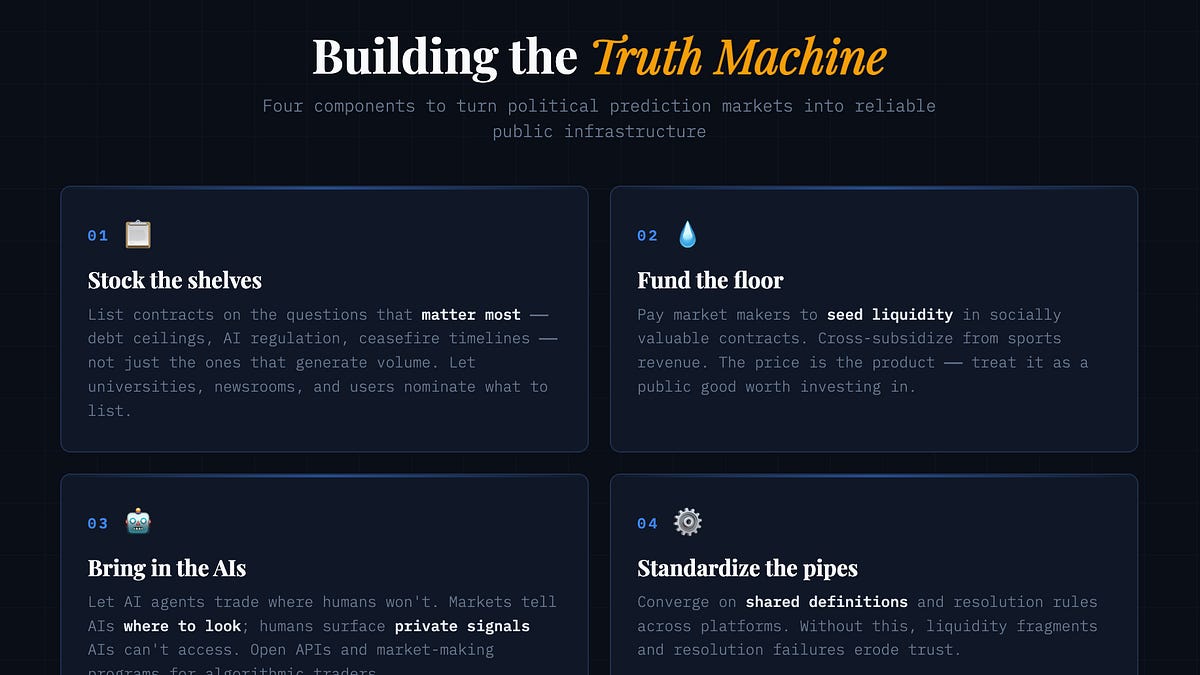
The Future of Truth Machines: What Traders Should Watch in 2026
As prediction markets mature, several technological and regulatory trends will shape how disputes are handled. Understanding these developments helps traders position themselves for the evolving landscape.
- Standardization push: Industry consortiums are developing standardized resolution rules to reduce ambiguity across platforms
- Cross-platform oracles: New protocols will allow markets on different platforms to reference the same oracle for consistent outcomes
- AI-human hybrid: The most successful platforms will combine AI speed with human judgment for complex disputes
- Regulatory evolution: CFTC is developing specific guidelines for automated dispute resolution systems in prediction markets
The push for standardization represents a significant shift in the prediction market industry. Currently, each platform maintains its own dispute resolution processes, creating potential inconsistencies when similar events occur across different markets. The newly formed Prediction Market Standards Consortium aims to establish common protocols for handling candidate withdrawals, election disputes, and other recurring scenarios.
Cross-platform oracle protocols could solve one of the industry’s biggest challenges: inconsistent outcomes across exchanges. If Polymarket and Kalshi both reference the same decentralized oracle for election results, traders won’t face situations where winning positions on one platform become disputed on another. This interoperability could significantly reduce systemic risk in the prediction market ecosystem.
Key Takeaways for Traders: Navigating Dispute Resolution
Understanding how exchanges handle disputes is essential for successful prediction market trading. These insights help traders manage risk and capitalize on opportunities that arise during dispute periods.
- Monitor dispute windows: Track when markets enter dispute periods to anticipate price volatility and liquidity constraints
- Understand platform differences: Know whether your platform uses community voting (UMA) or expert panels (Kalshi) for dispute resolution
- Watch for clarifications: Major unexpected events often trigger clarification votes that can significantly impact market outcomes
- AI integration benefits: Platforms with AI-assisted dispute resolution typically have higher accuracy and faster settlement times
The most successful prediction market traders treat dispute resolution as a strategic consideration rather than an operational detail. They know that UMA’s community voting system creates opportunities for informed traders to influence outcomes, while Kalshi’s expert panel requires understanding the decision-making criteria of former regulators.
During dispute periods, liquidity often dries up as uncertainty increases. Savvy traders maintain smaller positions in markets approaching resolution and increase position sizes in markets with clear, objective outcomes. They also track the dispute history of different platforms, knowing that some exchanges have better track records for accurate and timely resolutions.
As AI continues to transform dispute resolution, traders should favor platforms that transparently integrate these technologies while maintaining human oversight for complex cases. The future belongs to exchanges that can balance the speed of automation with the judgment of experienced reviewers, creating a “truth machine” that serves both market efficiency and trader protection. Understanding prediction market liquidity mining programs can provide additional yield opportunities during dispute periods when traditional trading strategies may be constrained.