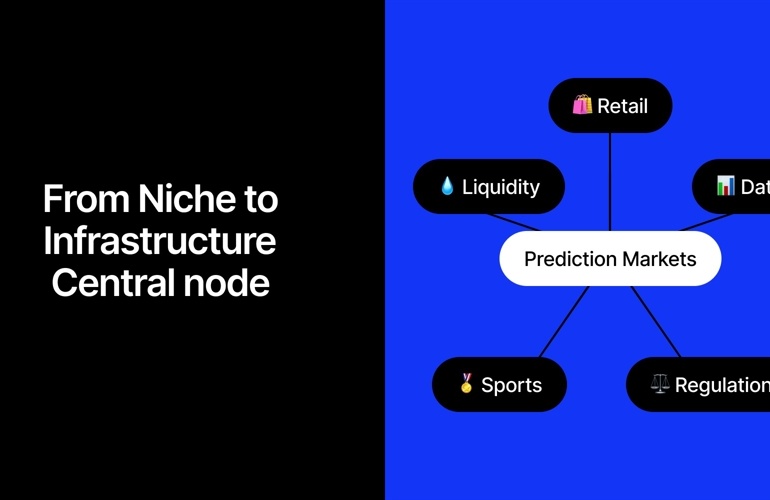

In 2026, sports event contracts are experiencing explosive growth, with approximately 90% of all prediction market trading volume driven by sports according to a February 2026 report. Major exchanges like Polymarket and Kalshi have seen open contracts reach $13 billion by the end of 2025, creating unprecedented opportunities for traders who understand how to identify mispriced underdogs and exploit market overreactions.
The Sports Event Contract Market in 2026: 90% Volume Growth and What It Means for Traders

According to a February 2026 report, approximately 90% of all prediction market trading volume is sports-related, with major exchanges like Polymarket and Kalshi seeing open contracts reach $13 billion by the end of 2025.
The shift from traditional sports betting to peer-to-peer event contracts represents a fundamental market transformation. Unlike bookmaker odds, these contracts operate as a true exchange where traders buy and sell positions directly, eliminating the house vig advantage. This creates a more efficient market where price discovery happens through collective wisdom rather than bookmaker margins. For those new to this format, understanding event contracts for sports betting is essential before trading.
The real-time settlement capability of these contracts creates new trading opportunities that don’t exist in traditional betting. Traders can exit positions before event resolution, locking in profits or cutting losses based on live game developments. This dynamic creates what industry analysts call a “sports flywheel” effect, where information flows continuously and prices adjust in real-time. For those interested in regulated platforms, Kalshi sports event contracts explained provides insights into federally regulated trading.
Why Sports Contracts Are Different from Traditional Betting
Peer-to-peer exchange mechanics fundamentally change how sports trading works. Instead of betting against a bookmaker with built-in margins, traders are matching with other market participants. This creates more competitive pricing and eliminates the traditional vig that erodes long-term profitability. For newcomers, betting on sport outcomes with event contracts offers a different approach than traditional sportsbooks.
The ability to exit positions before event resolution transforms sports trading from a binary outcome to a continuous process. A trader who identifies a mispriced underdog can buy contracts early, then sell at a profit when the market corrects, regardless of the final game outcome. This flexibility is impossible in traditional sports betting.
Price discovery through market participants rather than bookmakers means that true probabilities emerge through collective trading activity. When thousands of traders with different information sets interact, the resulting prices reflect a more accurate assessment of event likelihood than any single bookmaker could provide.
Identifying Mispriced Underdogs: The Three Critical Signals

Exploiting the favorite-longshot bias requires monitoring sudden liquidity drops, disproportionate whale activity, and market reactions to single news events that don’t reflect true win probability.
The favorite-longshot bias has been well-documented in prediction markets, but identifying when it creates profitable opportunities requires sophisticated signal detection. Research shows that low-price contracts (longshots) win less often than needed to break even, while high-price contracts (favorites) offer a better, small positive return. This creates systematic mispricing that skilled traders can exploit (Premier League title race prediction markets 2026).
Signal 1 focuses on liquidity concentration shifts. When large positions suddenly appear or disappear from the order book, it often indicates whale positioning. These institutional traders typically have superior information or analysis capabilities, and their movements can signal mispricing before the broader market adjusts. Monitoring whale wallet activity through automated bots provides early warning of potential opportunities.
Signal 2 involves cross-platform price discrepancies. When the same event shows different probabilities across exchanges like Kalshi, Polymarket, and Limitless, it creates arbitrage opportunities. These discrepancies typically range from 3-5% and represent market inefficiencies that can be exploited before prices converge. Cross-platform arbitrage scanners can identify these opportunities in real-time. For advanced traders, sports arbitrage using event contracts has become a key strategy in 2026.
Signal 3 examines social sentiment divergence from contract pricing. When social media reactions to news events don’t align with contract price movements, it often indicates market overreaction or underreaction. Automated tools that scrape social media platforms and compare sentiment to pricing can identify these divergences before they correct.
Real-Time Monitoring Tools for Underdog Detection
Automated bots tracking whale wallet activity have become essential for serious traders. These tools monitor large transactions across multiple platforms, identifying when significant capital enters or exits positions. The transparency of blockchain-based exchanges like Polymarket makes this monitoring possible, giving traders access to information previously available only to institutional players.
Cross-platform arbitrage scanners continuously compare prices across exchanges, alerting traders to discrepancies that can be exploited. These tools typically monitor 10-15 major platforms simultaneously, identifying opportunities within seconds of price divergence. The speed advantage is crucial, as these inefficiencies often correct within minutes.
Social media sentiment analysis integration has evolved significantly in 2026. Tools like “Scorecast,” launched in January 2026, use machine learning to analyze social media reactions and compare them to contract pricing. This data-driven approach helps traders identify when market reactions are driven by emotion rather than probability.
Market Overreaction Exploitation: A Step-by-Step Process
Market overreactions create profit opportunities when contract prices move 15-20% based on single news items, while true probability shifts only 5-7%.
Market overreactions represent one of the most reliable profit opportunities in sports event contracts. When news breaks about player injuries, weather changes, or coaching decisions, contract prices often overreact, creating temporary mispricing that skilled traders can exploit. The key is identifying when the price movement exceeds the actual probability shift.
Step 1 involves news event identification and initial price movement analysis. Traders need systems that can detect breaking news and immediately assess its impact on contract prices. This requires integration with news feeds, social media monitoring, and real-time price tracking across multiple platforms.
Step 2 focuses on cross-platform probability verification. When a news event causes price movement, traders should verify the reaction across multiple exchanges. If one platform shows a 20% price drop while others show only 5-7% movement, it likely indicates an overreaction on the first platform. Tools like PredScanner can help traders monitor these discrepancies in real-time.
Step 3 addresses position entry timing before herd movement. The optimal entry point is typically 2-3 minutes after the initial news reaction, when early traders have moved prices but before the broader market has fully reacted. This requires both speed and discipline to avoid chasing prices.
Step 4 covers exit strategy based on price correction patterns. Market overreactions typically correct within 15-30 minutes as more traders analyze the news and adjust their positions. Setting profit targets at 15-30% returns and stop-losses at 10% provides a structured approach to managing these trades.
Common Overreaction Triggers in Sports Markets
Player injury announcements remain the most reliable overreaction trigger. When a star player is reported injured, contract prices often drop 15-25% immediately, even though the true impact might only be 5-10%. This creates immediate profit opportunities for traders who can assess injury severity accurately.
Weather condition changes, particularly in outdoor sports, frequently trigger overreactions. A forecast change from sunny to rainy might cause a 10-15% price drop, but historical data shows the actual impact is often much smaller. Traders who understand weather’s true impact on game outcomes can profit from these overreactions.
Coaching decision leaks, such as unexpected lineup changes or strategic shifts, create volatile price movements. The market often overreacts to coaching changes that have minimal impact on game outcomes. Experienced traders who understand coaching tendencies can identify when these overreactions create profitable opportunities.
In-Game Trading Strategies for Real-Time Profit

Unlike traditional sports betting, these contracts allow for exiting positions early to lock in profits or cut losses based on real-time game developments, creating a ‘sports flywheel’ effect.
In-game trading has revolutionized sports event contracts, allowing traders to react to live game developments and adjust positions accordingly. This dynamic creates opportunities that don’t exist in traditional sports betting, where positions are locked until game conclusion. The ability to exit positions based on real-time information transforms sports trading from a static to a dynamic activity.
Live odds adjustment monitoring requires sophisticated tools that can track multiple games simultaneously. Traders need systems that can identify momentum shifts, scoring patterns, and other game developments that might affect contract prices. This requires both technical infrastructure and market knowledge to interpret what the price movements mean.
Momentum shift identification is crucial for successful in-game trading. When a team goes on a scoring run or a key player gets hot, contract prices often don’t immediately reflect the changing game dynamics. Traders who can identify these shifts early can position themselves for profit as the market catches up.
Position sizing for in-game volatility requires careful management. The rapid price movements during games mean that standard position sizing rules may need adjustment. Traders typically reduce position sizes during high-volatility periods to manage risk while maintaining the ability to profit from price movements.
Technical Requirements for Effective In-Game Trading
Low-latency internet connection is non-negotiable for in-game trading. Even minor delays can mean missing profitable opportunities or entering positions at worse prices. Traders typically invest in dedicated internet connections with speeds of at least 100 Mbps and latency under 20ms to major exchange servers.
Multiple platform access allows traders to compare prices and execute trades across exchanges simultaneously. This redundancy ensures that if one platform experiences issues, trading can continue uninterrupted. It also enables cross-platform arbitrage opportunities that arise during games.
Automated alert systems are essential for monitoring multiple games and identifying trading opportunities. These systems can track specific triggers like scoring events, momentum shifts, or price movements, alerting traders when conditions meet their trading criteria. This automation allows traders to monitor more games than would be possible manually (trading tennis match outcomes on event exchanges).
Advanced Portfolio Management for Sports Event Contracts
Professional traders manage sports contract portfolios by tracking correlation between different matches and implementing position sizing rules that limit exposure to any single event.
Portfolio management for sports event contracts requires understanding the complex correlations between different matches and events. Unlike traditional sports betting where each bet is independent, event contracts often have significant correlations that can amplify both profits and losses. Professional traders use sophisticated portfolio management techniques to optimize returns while managing risk.
Correlation analysis between related contracts helps traders understand how different positions might move together. For example, contracts for teams in the same division or conference often show significant correlation, as do contracts for teams that might meet in playoffs. Understanding these relationships allows traders to construct portfolios that are diversified across uncorrelated events.
Position sizing based on volatility metrics ensures that traders don’t overexpose themselves to high-volatility events. Events with high uncertainty or significant news flow typically require smaller position sizes to manage risk appropriately. Traders use historical volatility data and real-time market indicators to determine optimal position sizes.
Diversification across sports and timeframes reduces portfolio risk while maintaining profit potential. By spreading positions across different sports, leagues, and timeframes, traders can reduce the impact of any single event while maintaining exposure to multiple profit opportunities. This approach also helps manage the natural seasonality of different sports.
Risk Management Framework for Consistent Profit
Maximum position size limits of 2-5% of bankroll per event help prevent catastrophic losses. This rule ensures that no single event can significantly impact overall portfolio performance, even if the trader’s analysis proves incorrect. The exact percentage depends on the trader’s risk tolerance and the specific event’s volatility.
Stop-loss triggers based on market volatility provide automatic risk management. When positions move against the trader by a predetermined amount, typically 10-15%, the position is automatically closed to prevent further losses. These triggers are adjusted based on market conditions and the specific event’s characteristics.
Profit-taking thresholds at 15-30% returns ensure that profits are captured while allowing for continued upside potential. These thresholds are based on historical data showing that most price movements reverse after reaching certain levels. By taking partial profits at these levels, traders can lock in gains while maintaining exposure to continued price movement.
Building a Sustainable Trading Operation in 2026

The sports event contract market in 2026 offers unprecedented opportunities for traders who understand how to identify mispriced underdogs and exploit market overreactions. Success requires a combination of sophisticated tools, disciplined risk management, and continuous market analysis. Traders who master these elements can build sustainable operations that generate consistent profits. For those looking to elevate their trading, advanced strategies for sports event contracts provide professional techniques used by top traders.
The key to long-term success lies in treating sports event contracts as trading instruments rather than gambling. This means developing systematic approaches to market analysis, implementing rigorous risk management, and continuously refining trading strategies based on performance data. Traders who approach the market with this professional mindset are best positioned to profit from the opportunities that 2026’s rapidly growing market provides.
As the market continues to mature, the opportunities for skilled traders will only increase. The combination of technological advancement, regulatory clarity, and growing market liquidity creates an ideal environment for traders who are prepared to invest the time and resources necessary to develop expertise. Those who do will find themselves well-positioned to profit from one of the most exciting developments in sports trading history.