
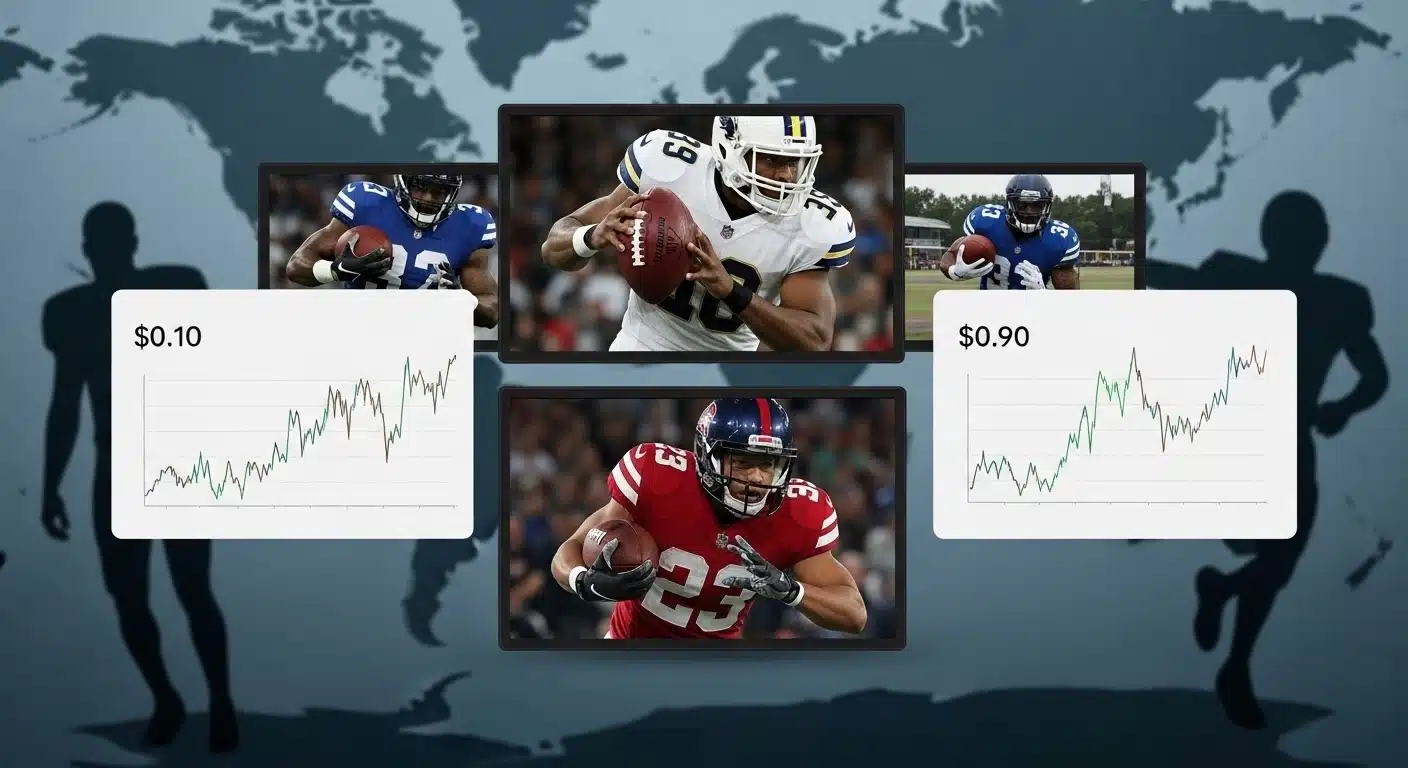
Event contracts transform sports betting into a high-speed, regulated financial market where traders buy and sell positions on specific outcomes, settling at either $0 or $1. Unlike traditional sportsbooks that take the opposite side of every bet, these contracts function as binary options—priced as probabilities where $0.60 means the market assigns a 60% chance of occurrence. This fundamental difference creates unique opportunities for traders who understand the mechanics behind probability pricing, regulatory advantages, and platform-specific liquidity dynamics. For those new to this space, betting on sport through event contracts offers a distinct approach compared to traditional wagering.
Event Contract Pricing vs Traditional Sportsbook Odds: The $0.60 vs +150 Difference
Event contracts price outcomes as probabilities (e.g., $0.60 = 60% chance), while traditional sportsbooks use American odds (+150 = 60% implied probability), creating arbitrage opportunities when markets misalign. The mathematical conversion between formats reveals when one market offers better value than another. For a +150 line, the implied probability equals 100 divided by (150 + 100), which equals 40%. When an event contract trades at $0.60 for the same outcome, the probability pricing suggests a 60% chance—a 20 percentage point discrepancy that represents potential value. Traders seeking to master these mechanics should explore the Event Contracts for Sports Betting: Complete Guide to Understanding Binary Outcomes for foundational knowledge.
Understanding Probability Mathematics for Sports Traders
Converting between American odds and event contract prices requires dividing 100 by (odds + 100) for positive odds, revealing when one market offers better value than another. For negative odds like -200, the calculation becomes 200 divided by (200 + 100), equaling 66.7%. This mathematical framework helps traders identify mispriced contracts across platforms. A common error new traders make is confusing the payout structure—event contracts require paying the market price upfront, while traditional bets risk the full stake for a potential profit. Tools like probability converters and odds comparison websites help traders quickly identify these discrepancies during live games.
CFTC Regulation vs State Gaming Laws: Why Event Contracts Work Nationwide
The Commodity Futures Trading Commission regulates event contracts as financial derivatives, allowing nationwide operation even in states where traditional sports betting remains illegal, unlike state-licensed sportsbooks. This federal oversight creates a unique advantage for traders in Texas, California, Florida, and other non-sports-betting states. While a bettor in Austin cannot legally place a wager on the Cowboys through traditional channels, they can trade Cowboys victory contracts on CFTC-regulated platforms with the same legal protections as commodity futures.
Tax Treatment Differences: Event Contracts vs Gambling Winnings
CFTC-regulated event contract profits are treated as capital gains rather than gambling winnings, potentially offering more favorable tax treatment and different reporting requirements for profitable traders. This distinction matters significantly for high-volume traders. Gambling winnings face ordinary income tax rates up to 37%, while capital gains for assets held over one year qualify for lower rates of 15-20%. Additionally, gambling losses can only offset gambling winnings, while capital losses provide broader deduction opportunities against other income types. Traders should consult tax professionals about Form 1099 reporting requirements, as CFTC-regulated platforms issue different tax documents than traditional sportsbooks.
Platform Liquidity Comparison: Kalshi vs Polymarket vs Crypto.com
Kalshi’s institutional market makers provide tighter spreads for major sports events, while Polymarket’s peer-to-peer model offers better liquidity for niche markets, and Crypto.com combines both approaches with crypto-native traders. For NFL games, Kalshi typically shows spreads of $0.01-$0.02 between bid and ask prices, reflecting deep institutional liquidity. College basketball games, particularly smaller conference matchups, often see tighter spreads on Polymarket where peer-to-peer trading concentrates on specific games. Crypto.com’s hybrid model attracts traders who want both institutional-grade liquidity and cryptocurrency settlement options. Understanding the mechanics of Kalshi sports event contracts explained can help traders navigate this federally regulated platform effectively (Premier League title race prediction markets 2026).
Real-Time Trading Mechanics During Live Events
Event contracts allow position adjustment throughout games, with prices fluctuating based on real-time action, enabling traders to lock in profits or minimize losses before final outcomes are determined. During a typical NFL game, contract prices might swing 20-30% based on scoring plays, injuries, or momentum shifts. A team leading by 10 points at halftime might see their victory contract price jump from $0.35 to $0.75, creating immediate profit opportunities for early position holders. Mobile app functionality varies significantly—Kalshi’s interface updates prices every 1-2 seconds, while Polymarket’s peer-to-peer matching can create slight delays during high-volume moments (trading tennis match outcomes on event exchanges).
Risk Management for Extreme Price Volatility
Successful event contract traders use position sizing limits (1-2% of bankroll per contract), stop-loss orders at 30% decline, and diversification across multiple uncorrelated events to survive rapid price swings. Bankroll management formulas suggest never risking more than 2% of total trading capital on any single outcome. For a $10,000 bankroll, this means maximum position sizes of $200 per contract. Stop-loss strategies might involve selling contracts if prices drop 30% from entry, limiting losses to $60 on a $200 position. Correlation analysis between different sports markets helps traders avoid overexposure—NBA and NHL games often move independently, while NFL and college football markets may show related patterns during overlapping timeframes.
Identifying Value: Spotting Misaligned Probabilities
Value exists when event contract prices diverge significantly from consensus probabilities derived from multiple sportsbooks, particularly in markets with lower liquidity or during rapid news events. Tools for probability aggregation might combine odds from five different sportsbooks to create a consensus line, then compare this against event contract pricing. A practical example: if consensus odds suggest a 55% probability for Team A winning, but their event contract trades at $0.40 (40% probability), this 15 percentage point gap represents potential value. Scanner setups can automate this process, flagging contracts that deviate by more than 10 percentage points from consensus across multiple data sources.
Advanced Cross-Platform Hedging Strategies
Traders can hedge positions across Kalshi and Polymarket by simultaneously taking opposite positions when pricing inefficiencies create risk-free profit opportunities, requiring careful monitoring of both platforms. A practical example: if Team A’s victory contract trades at $0.60 on Kalshi but $0.55 on Polymarket, a trader could buy the cheaper contract while shorting the more expensive one, locking in a theoretical $0.05 profit minus transaction costs. Capital requirements for effective cross-platform arbitrage typically start at $5,000 to absorb fees and price movements during execution. Automation tools can monitor both platforms simultaneously, alerting traders when spreads exceed transaction costs plus a profit threshold. Those interested in systematic approaches can find detailed methods in the Sports Arbitrage Using Event Contracts 2026: Risk-Free Profit Strategies Across Platforms guide.
Building a Sustainable Trading System
Consistent profitability requires systematic approach: daily market scanning, strict position sizing, regular performance review, and continuous education on both sports analytics and market microstructure. A daily routine checklist might include: scanning overnight line movements, identifying contracts with significant probability shifts, reviewing previous day’s trades for lessons learned, and updating position sizing based on recent performance. Performance metrics to track include win rate, average profit per winning trade, average loss per losing trade, and maximum drawdown. Educational resources range from sports analytics courses to books on market microstructure and behavioral finance. The most successful traders combine deep sports knowledge with understanding of how markets price information and react to new data. For traders looking to elevate their approach, the Advanced Strategies for Sports Event Contracts: Professional Trading Techniques 2026 resource provides sophisticated frameworks (strategies for profit in sports event contracts).
Event contracts represent a fundamental shift in how sports outcomes are traded, offering advantages in regulation, tax treatment, and trading flexibility that traditional sportsbooks cannot match. By understanding probability mathematics, platform differences, and risk management techniques, new traders can navigate this evolving market with confidence. The key lies in treating sports trading as a financial market rather than gambling, applying systematic analysis and disciplined execution to achieve consistent results.