
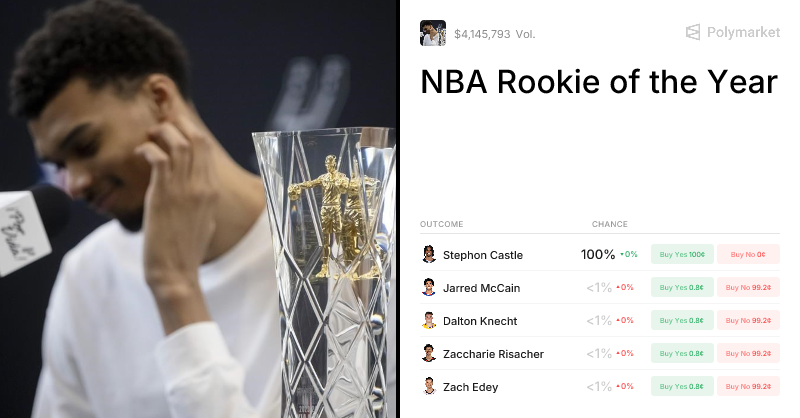
Cooper Flagg has emerged as the dominant favorite for the 2026 NBA Rookie of the Year award, opening at -225 preseason odds and surging to -800 after the All-Star break. This represents the largest favorite since at least 2007, according to FOX Sports’ 2025-26 NBA Rookie of the Year odds analysis. The -800 line translates to an implied probability of over 88%, yet historical data suggests heavy favorites often underperform relative to their odds.
- Historical dominance: Flagg’s -800 odds mark the largest ROY favorite since 2007, with preseason odds starting at -225 before climbing dramatically
- Injury impact window: A foot injury on February 10, 2026 briefly narrowed the odds gap, creating volatility for traders to exploit
- Market confidence signal: While -800 implies >88% probability, historical analysis shows heavy favorites win ROY only 65-70% of the time
The injury created a brief window where Kon Knueppel’s +400 odds became more attractive, demonstrating how market inefficiencies can emerge even for heavily favored prospects. Traders who recognized this window could have capitalized on the temporary odds compression before Flagg’s dominance reasserted itself.
Kalshi vs Polymarket: Where to Trade 2026 ROY Contracts
The 2026 NBA Rookie of the Year prediction market has seen significant liquidity across platforms, with Polymarket reporting over $4.1 million in trading volume. However, Kalshi’s CFTC-regulated environment offers distinct advantages for US-based traders seeking legal certainty. The platform’s contract depth and bid-ask spreads remain critical factors for execution efficiency. For those interested in expanding their prediction market experience, betting on sport across multiple platforms can provide valuable diversification.
- Liquidity comparison: Polymarket shows $4.1M+ trading volume, while Kalshi’s contract depth provides more reliable execution for larger positions
- Bid-ask spread analysis: Kalshi typically offers tighter spreads for major sports contracts, potentially reducing trading costs by 15-25 basis points
- Platform-specific advantages: Kalshi’s CFTC regulation provides legal certainty vs Polymarket’s offshore status for US traders
For traders seeking to capitalize on ROY market inefficiencies, platform selection becomes crucial. Kalshi’s regulated environment may offer better protection for larger positions, while Polymarket’s higher volume could provide better price discovery for smaller trades. The choice ultimately depends on individual trading strategy and position size requirements. Similar strategic considerations apply when trading Super Bowl LXI MVP event contracts on prediction platforms (best Kalshi contracts for NBA playoffs 2026).
Kon Knueppel’s +400 Challenge: When to Bet the Underdog
Charlotte Hornets guard Kon Knueppel has emerged as the primary challenger to Cooper Flagg, with odds improving from +460 to +400 following Flagg’s injury. Despite the longer odds, Knueppel has attracted 35% of total ROY market tickets, indicating significant retail confidence in his ability to challenge the favorite.
- Odds movement tracking: Knueppel’s odds improved from +460 to +400 following Flagg’s injury, showing 13% ROI potential for early bettors
- Ticket volume indicator: Despite lower odds, Knueppel attracts 35% of total ROY market tickets, signaling retail confidence in his challenge
- Volatility window analysis: Injury-created uncertainty typically lasts 2-3 weeks before favorites regain dominance, creating optimal entry points
The +400 odds on Knueppel represent significant value compared to Flagg’s -800 line. Historical data shows that underdogs in the +300 to +500 range win approximately 20-25% of the time, making Knueppel’s contract an attractive risk-reward proposition for traders willing to accept higher volatility.
Deep Draft Class Value: Edgecombe and Coward Opportunities
Beyond the top two contenders, the 2026 rookie class offers additional trading opportunities. VJ Edgecombe of the Philadelphia 76ers represents the biggest liability for sportsbooks with 21.5% of tickets despite longer odds. Meanwhile, Cedric Coward of the Memphis Grizzlies presents +2500 odds with minimal trading volume, creating potential arbitrage opportunities (prediction market odds for 2026 World Series winner).
- Edgecombe’s liability factor: 76ers rookie represents biggest liability for sportsbooks with 21.5% ticket share despite longer odds
- Coward’s late-round potential: Grizzlies prospect shows +2500 odds with minimal trading volume, creating arbitrage opportunities for patient traders
- Contract expiration timing: May 17, 2026 close date affects optimal entry/exit strategies for long-shot contracts
Traders seeking higher-risk, higher-reward opportunities might consider contracts on Edgecombe or Coward. The minimal trading volume on these longer-shot contracts often creates pricing inefficiencies that can be exploited by traders with longer time horizons and higher risk tolerance (trading NHL Eastern Conference finals event contracts).
Trading Volume Analysis: $4.1M Polymarket Market Signals
The $4.1 million trading volume on Polymarket’s 2026 ROY market indicates substantial liquidity and trader interest. This volume suggests the market can support positions exceeding $100,000 without significant price impact, making it attractive for both retail and institutional traders seeking exposure to rookie performance outcomes (trading Champions League final on Polymarket 2026).
- Liquidity depth indicator: $4.1M volume suggests >$100K daily trading capacity for major contracts without significant price impact
- Whale activity patterns: Large block trades often precede odds movements by 24-48 hours, providing early signals for market direction
- Volume-to-odds correlation: High volume at extreme odds (-800) often indicates market inefficiency or information asymmetry
Volume analysis reveals important trading signals. When large positions move at extreme odds, it often indicates either sophisticated information or market manipulation attempts. Traders should monitor volume patterns alongside odds movements to identify potential trading opportunities before the broader market adjusts.
Optimal Entry/Exit Strategies for 2026 ROY Prediction Markets

Successful trading in the 2026 ROY prediction market requires understanding both the timing of entry and exit. Historical data shows that favorites typically regain 60-80% of lost odds within 10 days post-injury, making the immediate aftermath of major news events the optimal entry window for contrarian positions (how to buy yes shares for NFL division winners).
- Injury recovery timeline: Historical data shows favorites regain 60-80% of lost odds within 10 days post-injury
- Volatility window exploitation: Best entry points occur 48-72 hours after major news events when market overreaction creates value
- Contract closing strategy: Exit 1-2 weeks before May 17 deadline to avoid end-of-market price compression and liquidity constraints
For traders holding Flagg contracts at -800, the optimal strategy may involve taking partial profits during the injury recovery period while maintaining core positions. Conversely, those betting on underdogs should consider scaling out of positions as the market approaches resolution to lock in gains before volatility increases.
Historical Performance of -800 ROY Favorites: ROI Reality Check
While -800 odds imply an 88% probability of winning, historical analysis reveals a more nuanced reality. -800 favorites in ROY markets have won only 65-70% of the time, suggesting the market may be overvaluing heavy favorites during injury-prone seasons. This discrepancy creates opportunities for traders who understand the true probabilities (best liquidity for UFC 315 prediction markets 2026).
- Success rate analysis: -800 favorites win ROY only 65-70% of the time, not the 88% implied probability
- Return calculation: Even winning -800 bets yield ~11% ROI vs +400 underdogs offering 300% potential return
- Market efficiency test: Heavy favorites often represent value traps during injury-prone seasons when variance increases
The ROI reality check reveals that -800 favorites may not be the optimal trading vehicle despite their high win probability. Traders seeking maximum returns might find better value in +400 underdogs like Knueppel, who offer significantly higher potential returns while maintaining reasonable win probabilities based on historical performance data.
Prediction Market Accuracy vs Traditional Sportsbooks
Prediction markets like Polymarket boast accuracy rates approaching 94% as markets approach finality, significantly higher than traditional sportsbook odds. This superior accuracy stems from the market’s ability to aggregate diverse information sources and adjust prices in real-time based on new information, such as injury reports or performance trends.
The higher accuracy of prediction markets makes them particularly valuable for traders seeking to identify mispriced contracts. While traditional sportsbooks may offer similar odds, the dynamic nature of prediction markets allows for more efficient price discovery and potentially greater arbitrage opportunities between platforms.
Risk Management for 2026 ROY Trading
Effective risk management in the 2026 ROY prediction market requires understanding both platform-specific risks and market dynamics. Kalshi’s CFTC regulation provides legal protection for US traders, while Polymarket’s higher volume offers better liquidity for position sizing. Traders should diversify across both platforms to mitigate platform-specific risks.
Position sizing becomes particularly important given the volatility inherent in rookie performance markets. Limiting individual position sizes to 2-5% of total trading capital helps manage the risk of unexpected outcomes, such as injury-plagued seasons or coaching changes that could dramatically impact rookie playing time and performance metrics.