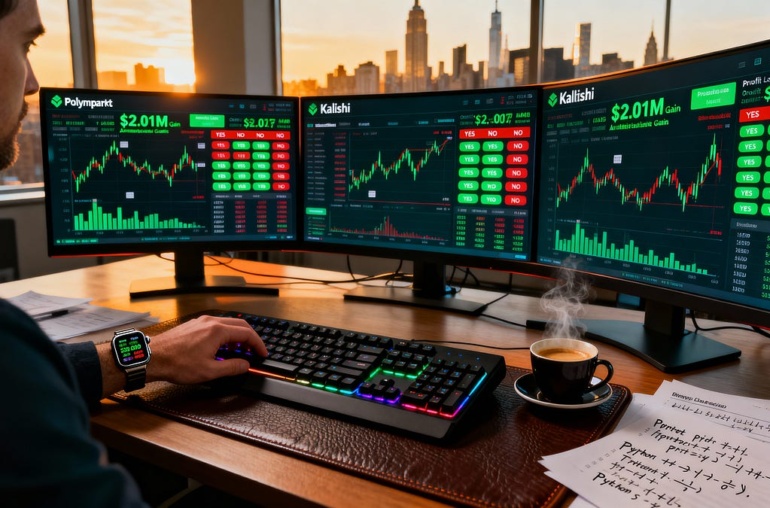
Prediction markets offer a fundamental economic advantage over traditional sportsbooks: zero vig. While sportsbooks build 10% margins into every bet, prediction markets operate on pure supply and demand economics. A $0.60 contract represents exactly 60% probability, with no house edge baked in. This mathematical transparency means traders capture the full value of their market insights, not just what’s left after the vig takes its cut.
The real-time odds advantage compounds this benefit. During NFL games, NBA quarters, or MLB innings, contract prices adjust instantly to new information. When a star quarterback leaves with an injury, the market reprices within seconds, not minutes like traditional sportsbooks. This speed creates arbitrage opportunities that vanish before conventional betting lines can react. The $0 to $1 binary contract system also eliminates the confusion of point spreads and moneyline odds, making probability-based trading accessible to anyone who can read a percentage.
Fee structures amplify these advantages in 2026. While sportsbooks charge 10-15% vig on losing bets, top prediction platforms like Polymarket operate with zero trading fees. Even platforms with minimal fees, such as Robinhood’s $0.01 per trade, pale in comparison to traditional betting costs. This fee differential alone can turn a break-even sports bettor into a profitable trader over hundreds of wagers.
CFTC vs State Laws: The Legal Loophole Making You Money

The 2026 legal landscape creates a fascinating regulatory arbitrage opportunity. The federal CFTC claims exclusive jurisdiction over prediction markets as financial derivatives, while state gaming boards in New Jersey, Nevada, and others attempt to regulate them as sportsbooks. This jurisdictional conflict creates access in states like California and Texas where traditional sports betting remains banned. Traders in these markets can access regulated platforms while neighbors are limited to offshore books.
Age requirements further tilt the playing field. Because CFTC regulation classifies prediction markets as financial instruments rather than gambling, many platforms allow users 18 and older. Traditional sportsbooks require 21+ in most jurisdictions. This two-year advantage means younger traders can start building market expertise and capital years earlier than their peers limited to conventional betting.
Security benefits of regulated Designated Contract Markets provide additional value beyond legal access. CFTC oversight requires segregation of customer funds, regular audits, and transparent settlement processes. Unlike offshore books that can disappear overnight, regulated platforms must maintain minimum capital reserves and follow strict reporting requirements. This regulatory framework protects traders from the counterparty risks that plague the traditional sports betting industry.
How to Read Binary Contract Prices Like a Pro Trader
Binary contract prices translate directly to probability percentages. A contract priced at $0.60 represents a 60% chance of the event occurring. If you believe the true probability exceeds 60%, the contract offers positive expected value. This simple mathematical relationship forms the foundation of profitable prediction market trading. Understanding this conversion allows traders to compare market prices against their own probability assessments and identify mispriced opportunities.
Price movement signals during live games reveal market psychology and information flow. When a basketball team goes on a 10-0 run, their championship contract might jump from $0.35 to $0.45 in minutes. These momentum shifts often overshoot the true probability change, creating temporary arbitrage opportunities. Experienced traders watch for these emotional overreactions, particularly during high-stakes moments like playoff games or rivalry matchups.
Volume analysis provides crucial context for price movements. A contract moving from $0.50 to $0.55 on $10,000 in volume suggests different market conviction than the same price change on $1 million in volume. High-volume moves indicate institutional money or significant information flow, while low-volume moves might represent noise or retail speculation. Tracking both price and volume helps traders distinguish between meaningful market signals and temporary fluctuations.
Platform Battle: Polymarket, Kalshi, and DraftKings Compared
Polymarket dominates the 2026 prediction market landscape with zero trading fees and the highest liquidity across sports contracts. The platform’s peer-to-peer structure means traders always compete against each other, not the house. This creates tighter spreads and more efficient pricing than traditional betting markets. Polymarket’s mobile app performance particularly excels for 0DTE (zero days to expiration) contracts, allowing traders to capitalize on news-driven volatility within single games (How to trade global conflict resolution prediction markets 2026).
Kalshi offers unique advantages through CFTC regulation as a Designated Contract Market. Beyond regulatory security, Kalshi pays 4%+ APY on cash held in accounts, effectively compensating traders for keeping capital ready. The platform’s user interface emphasizes simplicity, making it ideal for beginners transitioning from traditional sports betting. Kalshi’s settlement times typically range from 24-72 hours, faster than many competitors, though security holds of 3-30 days can temporarily lock profits.
DraftKings Predictions leverages the company’s massive user base to create liquidity in sports contracts while maintaining the familiar interface of traditional sports betting. The platform’s regulated status bypasses state-level sports betting bans in jurisdictions like California and Texas. However, DraftKings charges higher fees than pure prediction markets and offers less favorable odds due to their hybrid business model. The platform excels at marketing and user acquisition but lags in pricing efficiency compared to specialized prediction platforms (How to trade AI development milestone markets 2026 guide).
Building Your First Trading Dashboard
Essential metrics to track include open interest, bid-ask spread, and price momentum. Open interest reveals how many contracts are outstanding for each market, indicating liquidity and market depth. A contract with $100,000 in open interest trades more efficiently than one with $1,000. The bid-ask spread shows the immediate cost of entering and exiting positions; tighter spreads mean lower transaction costs and better execution prices. Price momentum indicators help identify trending markets versus range-bound conditions (How to trade crypto regulation outcome markets 2026 guide).
Real-time alert setup transforms passive observation into active trading opportunities. Configure alerts for specific price thresholds, volume spikes, or unusual order flow patterns. For example, set an alert when a team’s championship contract drops below $0.30 following a key injury announcement. These automated triggers ensure you never miss time-sensitive opportunities while avoiding the need to constantly monitor multiple markets simultaneously.
Risk management tools and position sizing protect your trading capital from inevitable losses. Limit exposure to 1-3% of total capital per position, regardless of how confident you feel about an outcome. Use stop-loss orders to automatically exit positions when prices move against you by predetermined amounts. Track your win rate and average profit/loss per trade to identify strengths and weaknesses in your strategy. Consistent risk management separates profitable traders from those who eventually blow up their accounts.
5-Minute NFL Trade: A Live Example

Monday Night Football provides the perfect laboratory for prediction market trading. Consider a game where the underdog opens at $0.45 probability. Within the first quarter, they score an early touchdown, and their contract jumps to $0.55. This 22% price increase reflects the market’s updated probability assessment. A trader who bought at $0.45 can now sell at $0.55 for a 22% return, minus any platform fees.
Entry point identification requires analyzing both market prices and fundamental factors. The $0.45 opening price might represent significant value if your analysis suggests the true probability should be closer to $0.50. Perhaps the underdog has a strong defensive matchup or the favorite’s star player is dealing with injury concerns not fully reflected in the market price. Successful traders combine quantitative analysis with qualitative insights about team dynamics, weather conditions, and recent performance trends (Analyzing prediction market performance during market volatility 2026).
Exit strategy execution determines whether a good entry becomes a profitable trade. Rather than holding through the entire game, consider taking partial profits as the price moves in your favor. Sell half your position at $0.50 for a quick 11% return, then let the remainder ride for potentially larger gains. Alternatively, set a stop-loss at $0.42 to protect against a scoreless first quarter that might send the price back toward $0.40. The key is having a predefined exit plan before entering any trade.
NBA In-Game Trading Strategies
Quarter-by-quarter probability shifts create predictable trading patterns in NBA games. The first quarter often sees the most volatility as teams establish their rhythm and adjust to game conditions. A strong start by the underdog can create temporary mispricing as the market overreacts to small sample sizes. The second and third quarters typically feature more stable pricing as the market incorporates more data about team performance and coaching adjustments.
Star player injury impact on contract pricing represents one of the most dramatic market movements in sports prediction trading. When a team’s leading scorer exits with an injury, their championship contract might drop 15-25% instantly. However, the market often overreacts to the immediate impact while underestimating the team’s ability to adjust through substitutions and tactical changes. Traders who can accurately assess injury severity and team depth can profit from these emotional market reactions.
Momentum trading during timeouts exploits the market’s tendency to extrapolate short-term trends. When a team goes on a 12-2 run to close a quarter, their contract price often continues rising during the subsequent timeout as traders project the momentum forward. However, defensive adjustments and fatigue often reverse these trends in the following minutes. Successful timeout traders fade extreme momentum moves, buying the underperforming team and selling the overperforming team as the market resets.
The Draft Stock Model: Trading Non-Game Outcomes
Combine performance markets represent a unique prediction market opportunity that traditional sports betting cannot replicate. Traders can speculate on 40-yard dash times, vertical jump measurements, and bench press repetitions before the NFL Draft. These measurable athletic feats create objective resolution criteria and eliminate the subjective elements of game performance. A player running a 4.3-second 40-yard dash might see their draft position contract jump from $0.15 to $0.25, reflecting improved first-round probability.
Player transfer probability contracts allow traders to speculate on offseason movement before it becomes public knowledge. When a star player’s contract approaches its final year, their likelihood of changing teams becomes a tradable market. These contracts often price in public rumors and media speculation, creating opportunities for traders with superior information or analytical models. The settlement criteria typically require official announcements from teams or players, providing clear resolution mechanisms.
Rookie draft position speculation extends beyond individual player markets to team-level predictions. Traders can speculate on which teams will select in each draft position or how many players from specific colleges will be drafted in the first round. These markets require understanding team needs, draft strategies, and the complex interplay between different teams’ selection priorities. The settlement typically occurs during the draft itself, creating a clear timeline for position management.
MLB Season-Long Portfolio Strategy
Division winner contracts across 162 games require a fundamentally different approach than single-game trading. Rather than focusing on individual matchups, successful MLB portfolio traders analyze long-term probability distributions and regression to the mean. A team starting 15-5 might see their division contract price jump from $0.35 to $0.55, but their true probability of winning the division might only increase to $0.45 due to the small sample size and historical regression patterns.
Player award markets (MVP, Cy Young) combine season-long performance tracking with narrative momentum. These contracts often price in both statistical projections and media narratives about player storylines. A pitcher with a 1.80 ERA through June might see their Cy Young contract rise from $0.25 to $0.40, but traders must consider schedule difficulty, injury risk, and historical voting patterns. The settlement occurs at season’s end, requiring patience and position management over months rather than days.
World Series path analysis involves trading on series-length probabilities and matchup-specific outcomes. Rather than simply betting on which team wins, traders can speculate on whether a series will end in four, five, six, or seven games. These markets require understanding both team strengths and the psychological dynamics of playoff baseball. A team with dominant starting pitching might be more likely to win in four or five games, while evenly matched teams often extend to six or seven games.
First Trade Checklist: Your 2026 Action Plan

Account setup and verification steps begin with selecting a CFTC-regulated platform like Kalshi or Polymarket. Complete the KYC (Know Your Customer) process by uploading government-issued identification and proof of address. Link your bank account or cryptocurrency wallet for deposits and withdrawals. Enable two-factor authentication to secure your account against unauthorized access. Start with a small initial deposit of $100-200 to learn the platform mechanics without significant risk.
Initial $100 trading strategy focuses on high-probability, low-volatility markets to build confidence and understanding. Look for contracts priced between $0.45 and $0.55 that offer clear resolution criteria. For example, bet $50 on a team with a $0.48 contract if your analysis suggests they have at least a 52% chance of winning. This approach provides a margin of safety while still offering potential returns. Track your trades meticulously to identify patterns in your decision-making and outcomes.
Common beginner mistakes to avoid include overtrading, ignoring fees, and emotional decision-making. Resist the urge to trade every market or chase losses after a bad day. Remember that even zero-fee platforms like Polymarket have opportunity costs in terms of time and attention. Avoid letting recent wins or losses influence your probability assessments for future trades. Maintain a trading journal documenting your reasoning for each trade and the actual outcomes to improve your decision-making process over time.
When Oracle Disputes Kill Your Profit: Settlement Risks
How resolution works on regulated platforms follows strict CFTC guidelines for objective criteria. Sports contracts typically settle based on official league sources like ESPN, NFL.com, or team announcements. The oracle system must provide clear, verifiable outcomes within specified timeframes, usually 24-72 hours after the event concludes. This regulatory oversight reduces the settlement disputes common in traditional sports betting but doesn’t eliminate them entirely.
Historical examples of controversial outcomes include the 2020 MLB playoff tiebreaker situation and various NCAA basketball game protests. In these cases, the initial result differed from the final official outcome due to protests, official reviews, or rule interpretations. Prediction markets must honor the final official result, not the result at the time of the market’s conclusion. This can create situations where a contract appears to have resolved correctly but is later overturned by league officials.
Protection mechanisms for traders include platform reserves and dispute resolution processes. CFTC-regulated platforms must maintain capital reserves to cover all outstanding positions and potential disputes. If an oracle error occurs, platforms typically have appeal processes and may adjust settlements to ensure fairness. However, traders should understand that these protections have limits and that extreme outlier events can still result in losses despite regulatory oversight. Diversification across multiple markets and careful position sizing provide the best protection against settlement risks.
Internal Links: For more detailed platform comparisons, see our guide on Comparing Retail vs Institutional Prediction Market Platforms 2026. Learn about hedging strategies in Using Prediction Markets for Insurance Risk Hedging 2026 Guide. Explore advanced trading techniques in Analyzing the Impact of High-Frequency Trading on Prediction Odds 2026.