
The digital asset landscape, for all its innovation, remains a wild frontier where the lines between opportunity and exploitation can blur. Recent allegations brought forth by the prominent on-chain investigator ZachXBT against Broox Bauer, a manager at the Axiom trading platform, serve as a stark reminder of the constant vigilance required. The core of the accusation centers on the alleged abuse of internal access to sensitive user data, facilitating what amounts to insider trading within the volatile meme coin market.
From a practitioner’s standpoint, this isn’t just another headline; it’s a case study in operational security failures and the human element in financial misconduct. The claim is that Bauer, leveraging privileged access to Axiom’s internal systems, was able to uncover the ‘hidden’ wallets of influential crypto figures. This was reportedly achieved by cross-referencing referral codes and unique user identifiers (UIDs) – a method that, while seemingly technical, points to a fundamental breach of trust and data integrity.
The Mechanics of Alleged Exploitation
The alleged scheme was surprisingly straightforward, yet insidious in its execution. Once these ‘hidden’ influencer wallets were identified, the information wasn’t kept secret. Instead, it was purportedly shared with a network of accomplices. This group then compiled these addresses into a shared document, likely a Google spreadsheet, to meticulously track early purchases of meme coins by these key players.
This kind of pre-emptive intelligence is gold in the fast-paced world of meme coins. By knowing when a major influencer was accumulating a particular token, the alleged perpetrators could position themselves strategically. They could open their own positions well before the influencer’s public endorsement, effectively front-running the inevitable price pump that often follows such promotions. This isn’t just unethical; it’s a direct manipulation of market dynamics, leveraging privileged information for personal gain.
ZachXBT’s investigation wasn’t based on mere speculation. The detective presented compelling evidence, including screenshots from April and August 2025, which reportedly contained personal trading data. Furthermore, an audio recording was released where Bauer allegedly boasts about unrestricted access to any Axiom client’s information. This kind of bravado, often heard in the aftermath of a successful exploit, is a tell-tale sign of someone who believes they are untouchable. The fact that several alleged victims have since verified the authenticity of the disclosed addresses only adds weight to these serious claims.
Platform Response and Industry Implications
The response from the Axiom team was swift, if somewhat predictable. They expressed being ‘shocked and disappointed’ by the revelations. While such statements are standard, the immediate action of revoking employee access to support tools is a critical first step. The promise to hold those responsible accountable is also essential, not just for the integrity of Axiom but for the broader industry. When these incidents occur, they erode trust, which is the bedrock of any financial system, decentralized or not.
From an operational perspective, this incident underscores the perpetual challenge of balancing accessibility with security. Internal tools, designed to facilitate customer support and platform management, inherently require access to sensitive data. The design of these systems, the protocols for access, and the auditing mechanisms in place are paramount. This case highlights that even with robust technical safeguards, the human element—the insider threat—remains a significant vulnerability. It’s a constant cat-and-mouse game, where platforms must continuously adapt their security postures to counter evolving threats, both external and internal.
The Prediction Market’s Role: A Pre-Emptive Indicator
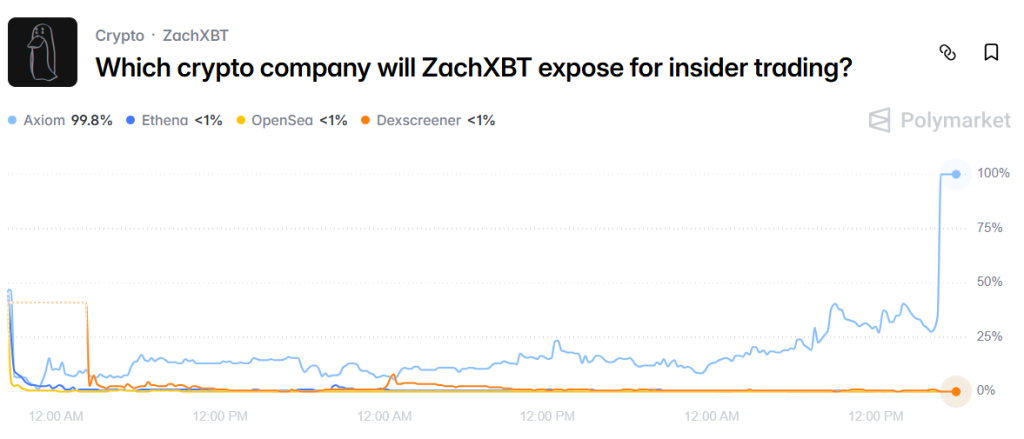
Interestingly, the unfolding of this scandal was foreshadowed by activity on the Polymarket prediction platform. This isn’t just a casual betting site; it’s a fascinating real-time barometer of collective intelligence and sentiment, often reflecting information that hasn’t yet gone mainstream. The sheer volume of bets on who ZachXBT’s next exposé would target, exceeding $38 million, indicates a significant level of public interest and, perhaps, insider knowledge circulating within certain circles.
The surge in Axiom’s ‘chances’ of being the subject of the investigation to 35% just hours before the official announcement is particularly telling. This isn’t mere coincidence; it suggests that information, or at least strong rumors, were already influencing market participants on Polymarket. This dynamic highlights the unique role of prediction market platforms like Polymarket and kalshi in the digital age. They can act as early warning systems, reflecting shifts in public perception and even pre-empting major news events, often before traditional media or official channels catch up.
For those of us who track these markets, observing the movement on Polymarket prior to a major reveal like this is a familiar pattern. It’s a testament to the efficiency of information dissemination, even if that information is speculative or unconfirmed at the time. It also raises questions about the ethics of trading on such pre-release information, even if it’s derived from a prediction market rather than a direct leak.
This isn’t the first time ZachXBT has called out questionable practices. Back in August 2025, the investigator famously labeled Ripple, Cardano, and Hedera as ‘insider enrichment schemes.’ This consistent pattern of uncovering alleged misconduct reinforces the critical role independent on-chain sleuths play in holding projects and individuals accountable within the often opaque world of decentralized finance. Their work, while sometimes controversial, is indispensable for maintaining a semblance of transparency and fairness in an ecosystem still grappling with regulatory frameworks and ethical standards.
The Axiom incident serves as a potent reminder that the pursuit of profit, when unchecked by ethical boundaries and robust security, can lead to significant breaches of trust. It’s a lesson for platforms to continually fortify their internal controls and for users to remain vigilant, understanding that even within seemingly secure environments, vulnerabilities can and do exist.