Throughout 2025, the Real World Assets (RWA) sector transitioned from theoretical discussions to aggressive integration with traditional financial markets. The focus has shifted from basic debt instruments toward energy resources and critical infrastructure, marking a significant maturation phase for blockchain-based asset tokenization.
In this analysis, we examine the architecture of emerging commodity markets, explore key startup implementations, and assess the risks within this developing financial landscape that bridges digital and traditional finance.
The Tokenization Evolution
By late 2025, BlackRock executives Larry Fink and Rob Goldstein described the convergence of traditional institutions and digital innovation as building bridges from opposite riverbanks:
“The two aren’t competing so much as learning to interoperate. In the future, people won’t keep stocks and bonds in one portfolio and crypto in another. Assets of all kinds could one day be bought, sold and held through a single digital wallet.”
Last year, the RWA sector emerged as the most profitable segment within cryptocurrency. Success, fueled by optimistic forecasts for real-world asset tokenization against a challenging blockchain industry backdrop, positioned this niche as essentially the sole investment hope for many market participants.
In October, Standard Chartered analysts projected RWA capitalization reaching $2 trillion by 2028. Following that, Grayscale forecasted a 1,000-fold expansion over the subsequent four years. ARK Invest joined this optimistic outlook, suggesting tokenization could potentially grow by up to 50,000% within five years.
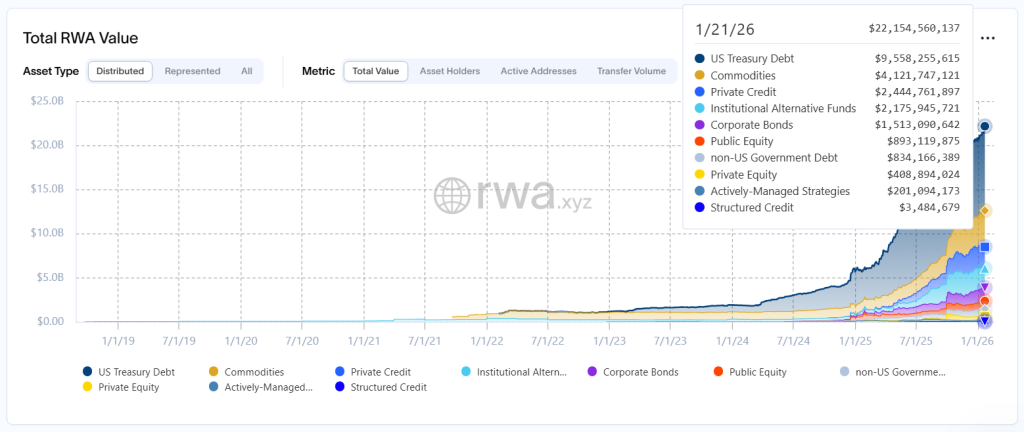
According to RWA.xyz data from January 22, 2026, the sector’s value excluding stablecoins surpassed $22 billion, with tokenized US government debt leading at $9.5 billion.
While US Treasuries initially drove this movement, startups now digitize pooled exposure to private corporate credit and real estate assets. The 2025 phenomenon involved trading public company equities on blockchain infrastructure, with many centralized and decentralized exchanges enabling this feature. Even Telegram users could purchase securities from traditional finance markets directly within the application.
The next frontier for RWA is taking shape around commodities. At the time of writing, this subcategory’s market capitalization stood at $4.8 billion, with over 80% represented by Tether Gold (XAUT) and Paxos Gold (PAXG). Despite pioneers tokenizing gold, silver, and other precious metals for more than five years, oil remained outside the scope until recently. Serious discussions about digital rights to oil assets began only about two years ago.
As regulatory clarity advances and tokenization technology matures, markets for oil, gas, and AI-critical inputs could join the RWA ecosystem—and potentially lead this trend—in the near future.
Subsurface Asset Economics
Tokenizing subsurface assets represents an under-the-radar trend within the broader RWA landscape: not yet supported by substantial reported figures, but already attracting early movers. Initial commodity experiments demonstrated how blockchain technology can rapidly pool liquidity into capital-intensive sectors, bypassing traditional banks struggling to meet the accelerating demands of the AI economy.
The tokenized commodities market has undergone natural selection. Early Solana-based startup Elmnts, which offered fractional participation in oil-production revenues, has been moved to withdrawal mode. The project’s social activity ceased just four months after its public beta launched in October 2024.
Projects that lost momentum for various reasons have given way to players with institutional backing and refined business models. Moreover, today’s regulatory environments in the US, EU, and UAE allow organizations to operate within well-defined legal parameters that early pioneers lacked.
Hadron by Tether provides turnkey tokenization services using institutional-grade verification and a broad product range that includes commodities. UAE-based Tharwa (TRWA) operates within Abu Dhabi’s financial center, focusing on Middle Eastern markets by tokenizing gold, real estate, and oil industry stakes. Its integration with the decentralized protocol Pendle enables investors to separately trade the base asset (Principal Token, PT) and expected yield (Yield Token, YT), providing access to sharia-compliant finance without Riba elements.
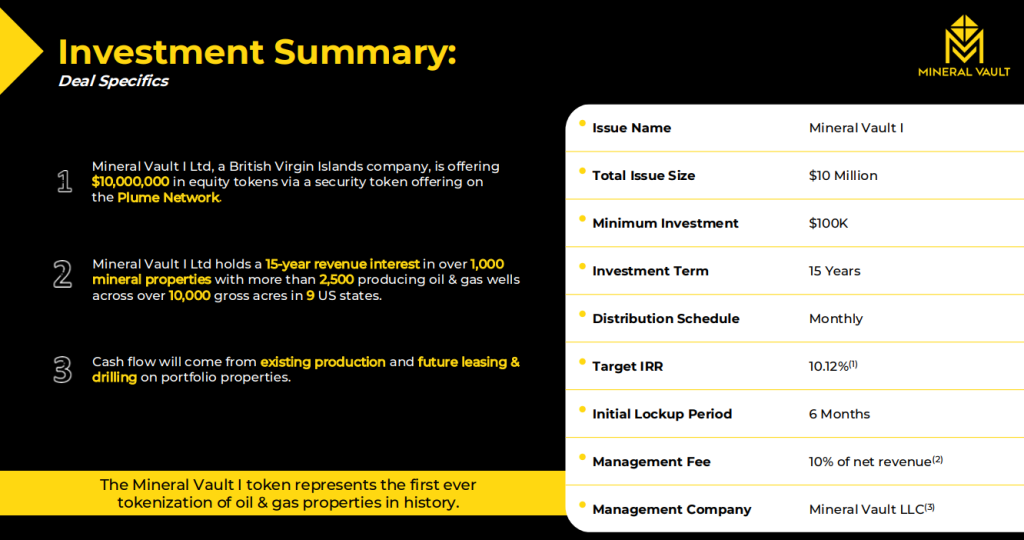
Another RWA startup, Mineral Vault (MNRL), selected the specialized Plume Network and offers built-in compliance mechanisms at the protocol layer. The team is working to tokenize royalties from 2,500+ oil and gas wells in the US owned by partner Allegiance Oil & Gas. Essentially, a holder of Mineral Vault I owns a share of mineral rights collectively valued at $10 million.
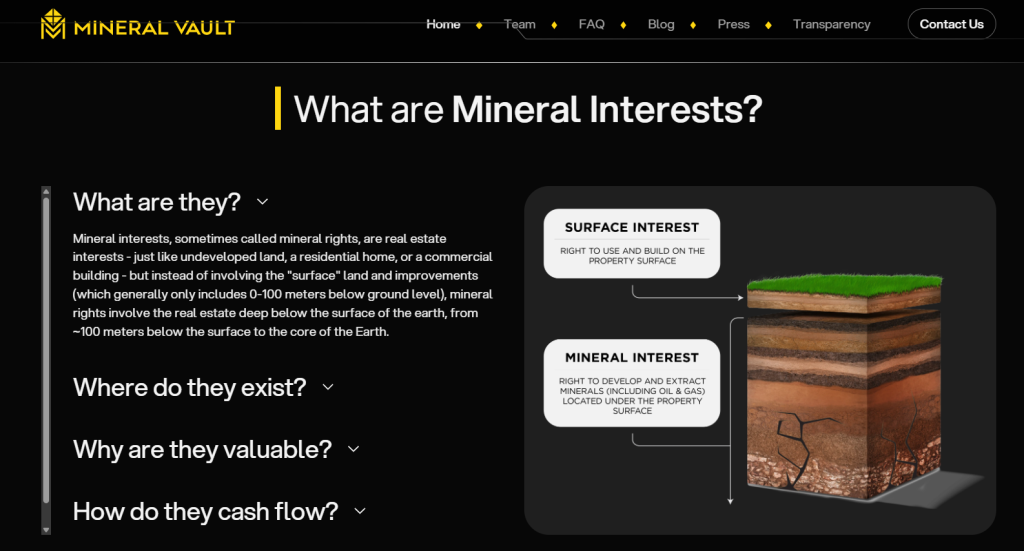
Mineral rights represent a distinct form of subsurface property granting owners extraction rights for oil, gas, and other resources beneath a parcel, independent of surface rights. These rights can be leased to American energy companies in exchange for royalty payments, allowing owners to receive passive income, inflation protection, and long-term appreciation while bearing virtually none of the costs or risks associated with drilling or maintaining wells.
The legal structure, built through bankruptcy-remote special-purpose vehicles, guarantees investor distributions in USDC stablecoin. With a target yield of 10-12%, these assets compete directly with traditional bonds.
On October 1, 2025, tokenization-as-a-service startup Zoniqx announced “the world’s first tokenized private placement in the oil sector” on Hedera. Developed with One World Petroleum support, the project combines acquisition of proven oil-producing assets with secured lending to operators. Each ownership unit is issued as a security token, ensuring automated regulatory compliance, investor rights verification, and full lifecycle management.
Today’s RWA sector enforces rights through purpose-built token standards:
ERC-7518 from Zoniqx builds on ERC-1155 but adds dynamic compliance. Unlike earlier versions, it’s designed for cross-chain transfers while preserving all legal constraints and owner data;
ERC-3643 functions as a “smart” token with built-in black- and whitelists, used by category leader Ondo Finance. Before each transaction, the algorithm queries an oracle to confirm: “Has the buyer passed KYC? Are they under sanctions? Is the buyer allowed to own this asset under their country’s laws?” Otherwise, the transaction is automatically blocked;
ERC-1400 represents one of the earliest and most flexible standards for tokenizing complex financial instruments. It supports collective asset ownership, partitioned rights (such as income or governance shares), court-ordered forced transfers, and attaching legal documents to token metadata;
ERC-4626 serves as the standard for tokenized yield vaults underpinning many RWA funds like Ondo OUSG and BlackRock BUIDL. It standardizes deposits, withdrawals, and yield accounting, simplifying their use as collateral in DeFi.
A notable real-world project was the USOR (U.S. Oil Reserve) token on Solana. In January 2026, it generated active social media discussion due to rumors of accumulation by BlackRock wallets and Donald Trump’s family. However, examination by Arkham Intelligence and a project audit revealed no actual connections to the US Department of Energy. The startup’s description contained technical inaccuracies and exhibited scam characteristics.
RWA once again demonstrated its significance not only for corporations but also for the current US presidential administration.
On January 22, American Resources Corporation, through subsidiary ReElement Technologies and blockchain infrastructure provider SAGINT, announced the successful issuance of the world’s first token for critical minerals. The project confirmed technical readiness to comply with US Defense procurement rules.
The utility token, issued on Sui, provides supply-chain traceability for refined neodymium oxide produced at ReElement’s plant in Noblesville, Indiana. It’s designed as an internal audit and compliance tool for the ReElement platform and its clients, integrating data and control protocols that meet required standards.
Re
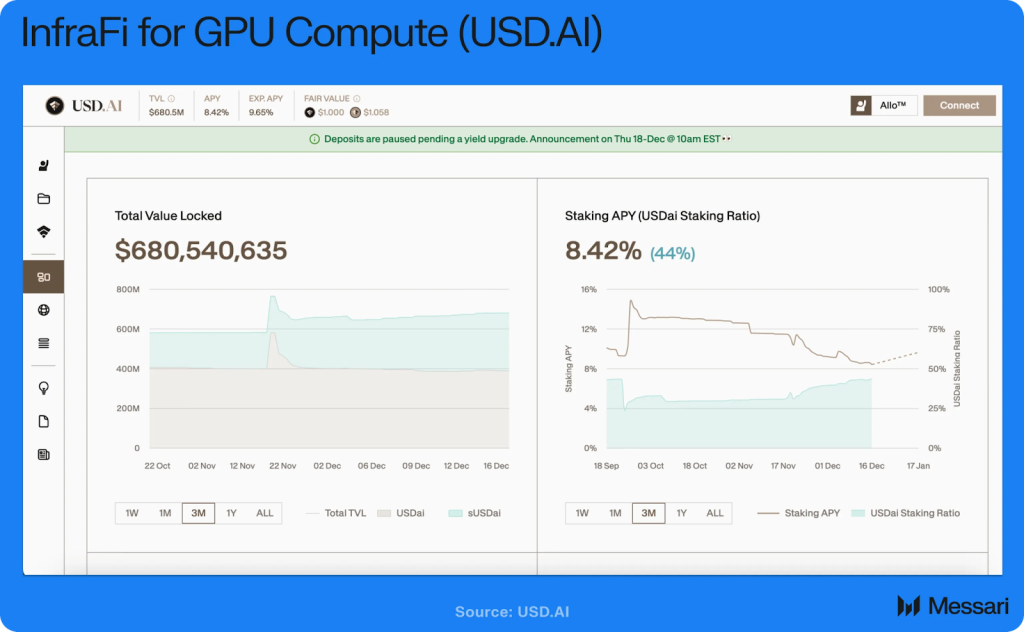
As Messari analysts noted in The Crypto Theses 2026, the response to traditional banking’s limitations is InfraFi—a breakthrough at the intersection of RWA and DePIN. Until 2025, most private on-chain lending attempts suffered from “toxic flow” and adverse selection. Goldfinch, conceived as a tool for efficient lending to emerging markets, encountered underwriting issues. The best borrowers gravitated toward traditional lenders, leaving on-chain pools with riskier assets. By 2026, the focus shifted from refinancing debt to creating new assets: tokenizing infrastructure (GPU, energy) secured by real-world objects, where income is generated through use rather than speculation.
Messari coined a term for linking on-chain capital with lending to real infrastructure whose yields don’t correlate with crypto volatility. Attention has moved toward productive assets and equipment generating predictable cashflows yet remaining outside traditional capital markets due to fragmented demand.
Transforming computational capacity into a standalone productive re
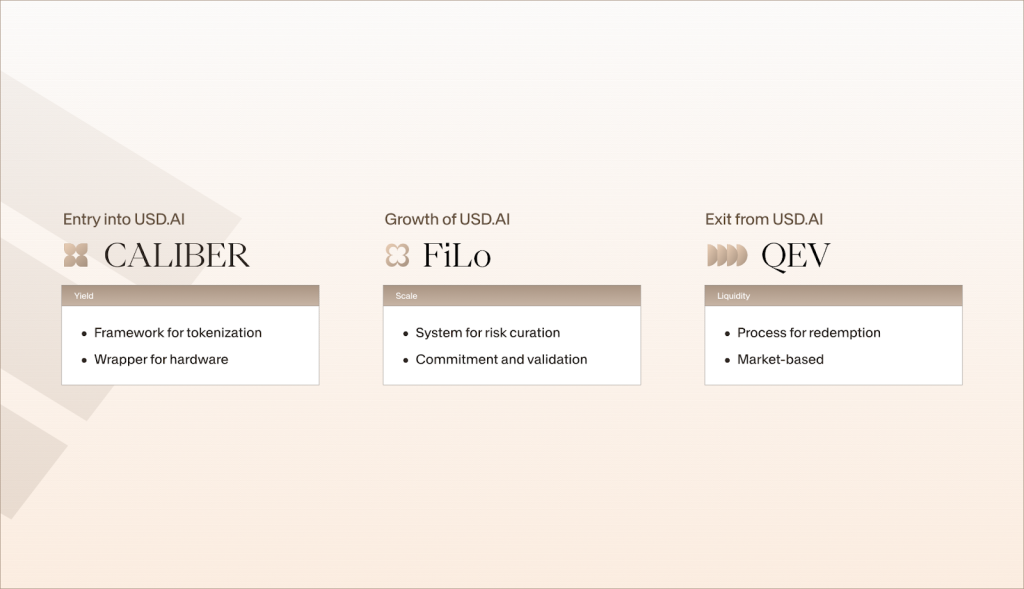
USD.AI addresses this gap through a combination of frameworks. The core innovation involves forgoing physical equipment ownership by the borrower:
placement — GPUs are delivered directly to a third-party data center;
usage rights — the borrower receives legal rights to operate the compute but not ownership until the three-year loan is fully repaid;
liquidation — in case of default, instead of court repossession, access rights to compute are reassigned
For InfraFi to function, reliable connections between on-chain systems and real-world assets and processes are critical. This is where blockchain oracles like Chainlink and Pyth come into play. The convergence of on-chain and off-chain worlds requires large, continuous data flows, which significantly increase these protocols’ applied value and their tokens’ worth. The segment’s undervaluation suggests a future rally as it becomes a foundational settlement layer for the new economy—a trend supported by recent developments.
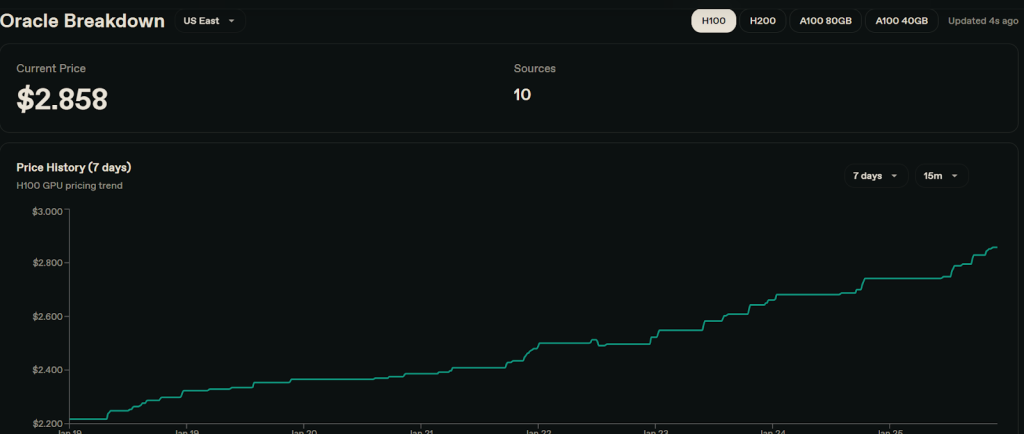
Oracle provider Chainlink launched 24/5 U.S. Equities Streams, supplying DeFi protocols with round-the-clock weekday quotes for American stocks and ETFs. As market structure grows more complex, indices and derivatives are becoming dominant instruments. As Messari notes, compute (GPU-hours) has become a new commodity. However, compute markets remain fragmented and opaque, with prices varying by chip (H100 vs A100), geography, and contract tenor.
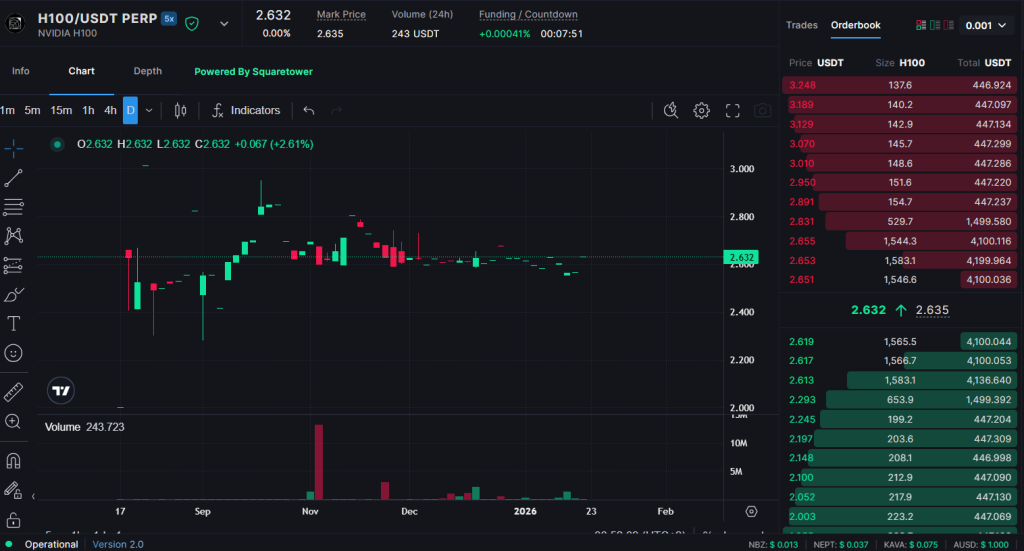
Projects like Ornn and Global Compute Index are creating a “gold standard” price for compute power by aggregating data worldwide. Squaretower launched GPU futures, allowing AI labs to lock in operating costs and hedge against chip shortages.
The RWA sphere demands thoughtful protection against very real threat vectors. The transparency required for market advantages becomes an Achilles’ heel when safeguarding large fortunes. A public wallet holding substantial stakes in oil rigs or GPU farms becomes a target. A potential solution lies with ZKP mechanics, which allow ownership proof without revealing balances.
For anchoring rights to strategic assets, PoW blockchains appear strongest; however, RWA predominantly uses specialized network approaches. Due to narrower scenarios, participant sets, lower economic diversification, and concentrated trust points, such networks may prove especially attractive to hackers.
Remember: blockchain protects ownership records, not the physical objects themselves. In the event of nationalization or destruction of a tokenized asset like an oil rig, the token becomes a claim on an insurer or the state. RWA effectiveness here depends directly on jurisdictional stability.