

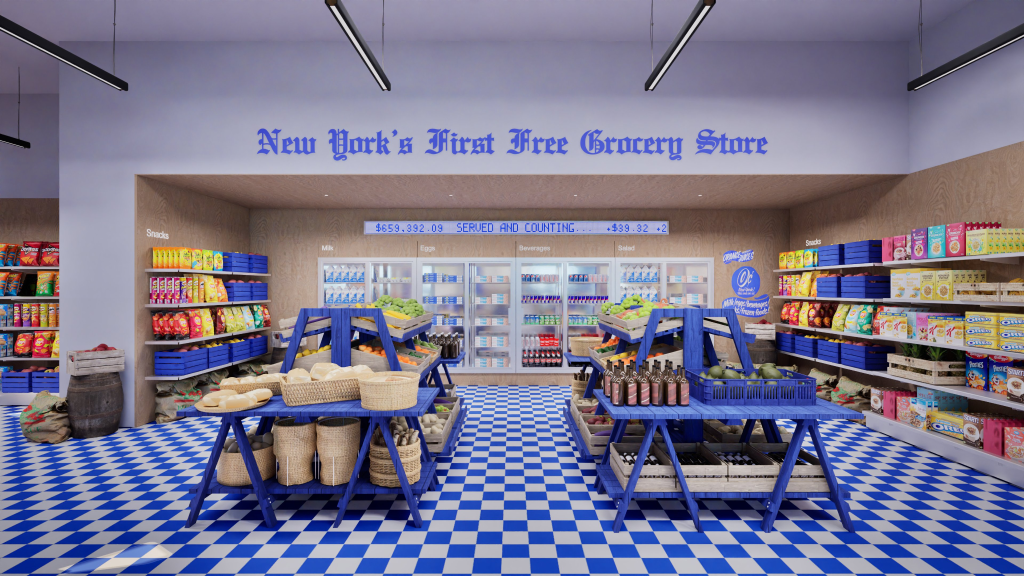
The prediction market space just got a lot more interesting—and a lot more physical. On February 3rd, Polymarket announced they’re opening “New York’s first free grocery store” in Manhattan. The store, called “The Polymarket,” will open its doors on February 12th at noon and run for five days. But this isn’t just a publicity stunt; the platform has also committed $1 million to Food Bank For NYC, an organization that works across all five boroughs to address food insecurity.
As someone who’s watched prediction markets evolve from niche crypto experiments to mainstream financial tools, I can tell you this move is calculated. The team behind Polymarket has been planning this for months, since at least November, according to community chatter. Their tagline says it all: “Free groceries. Free markets. Built for the people who move New York forward.” It’s a clever way to bridge the gap between digital speculation and real-world impact.
The Community’s Mixed Reaction
The response from the crypto community has been predictably divided. Some users are genuinely excited, with several offering to stock the store with their own products. Polymarket’s team indicated they might make this possible in the future, which could turn the store into a community-driven experiment. Others, however, took a more cynical approach, posting AI-generated images showing what the store might look like “a few days after opening.” The humor wasn’t lost on anyone familiar with the challenges of running a physical retail operation.
What most people don’t realize is the operational complexity behind a temporary retail space. Unlike a digital platform where you can scale instantly, a physical store requires inventory management, staffing, security, and compliance with local health codes. Polymarket’s team likely spent significant resources on logistics, permits, and insurance—costs that don’t appear in a simple $1 million donation figure. This level of commitment suggests they’re serious about brand building, not just viral marketing.
The Rivalry Heats Up
Just as Polymarket was making headlines, competitor Kalshi launched its own grocery promotion at Westside Market, offering $50 worth of groceries to the first 1,000 people. The line stretched for several blocks, and 1,795 people registered for the event. While impressive, the scale and execution felt rushed compared to Polymarket’s months of preparation.
The community didn’t hold back in its criticism. One user pointed out the stark contrast: “Polymarket had been preparing for this since November and donated $1m and you only $50? This is an attempt to steal the idea.” Another called Kalshi’s initiative “sad,” suggesting they could have simply partnered with Polymarket instead of launching a competing effort. From a strategic standpoint, the criticism is valid. Kalshi’s move appears reactive rather than proactive, a common mistake in fast-moving markets where first-mover advantage matters.
The Bigger Picture: Market Expansion
This grocery store battle is just one symptom of a much larger trend. Prediction markets are exploding in popularity, and major platforms are racing to capture market share. On February 2nd, Coinbase launched its own prediction platform in partnership with Kalshi. The product had been rumored since mid-December, but the launch triggered immediate legal battles.
Coinbase filed lawsuits against regulators in Michigan, Illinois, and Connecticut, arguing that prediction markets fall under the jurisdiction of the CFTC, not state gambling authorities. In response, Nevada’s gambling regulator sued Coinbase, accusing the exchange of running unlicensed sports betting. This regulatory tug-of-war highlights a fundamental tension: are prediction markets financial instruments or gambling? The answer will determine who controls them and how they’re taxed.
Meanwhile, Crypto.com carved out its prediction-market business into a separate platform called OG. CEO Kris Marszalek explained the move: “Over the past six months we have seen 40x weekly growth in our predictions business. Such growth warrants focused effort and a separate platform.” OG operates on Crypto.com Derivatives North America, a CFTC-registered exchange and clearinghouse, and is currently available only to U.S. users. This separation strategy makes sense—when a business unit grows fast enough, it often needs its own infrastructure and team to scale properly.
What This Means for Users
For everyday users, this competition is mostly good news. More platforms mean more options, better odds, and potentially lower fees. But there are hidden costs. Each new platform requires users to learn new interfaces, understand different fee structures, and navigate varying regulatory environments. The learning curve can be steep, especially for those new to prediction markets.
There’s also the issue of liquidity fragmentation. When users spread their capital across multiple platforms, it can reduce the depth of markets on each one, leading to wider spreads and less accurate pricing. This is a problem that even established platforms struggle with, and it’s likely to get worse before it gets better.
From a practitioner’s perspective, the most interesting development is the integration of prediction markets into broader financial ecosystems. Jupiter, a Solana-based liquidity aggregator, recently integrated Polymarket. Hyperliquid, a DEX for perpetuals trading, announced its own prediction-market platform. These integrations suggest that prediction markets are moving from standalone products to features within larger financial applications—a shift that could dramatically increase their reach and utility.
The Road Ahead
As we move through 2026, expect to see more of these real-world activations. Digital platforms are realizing that physical presence, even temporary, can build brand loyalty in ways that pure online marketing can’t. The grocery store stunt is clever because it ties the abstract concept of prediction markets to something tangible and universally understood: food.
But the real test will be what happens after the store closes. Will Polymarket see a sustained increase in user engagement? Will the $1 million donation translate into long-term brand equity? And will competitors like Kalshi learn from this and adjust their strategies, or will they continue to play catch-up?
One thing is certain: the prediction market space is no longer a niche corner of crypto. It’s becoming a legitimate financial sector, complete with regulatory battles, marketing wars, and real-world experiments. The grocery store is just the beginning.